

What Small Village Arunachal Taught Me About Human Nature Interactions

This article recounts insightful experiences gained from spending time in a small village in Arunachal Pradesh. It highlights how close interactions within a tight-knit community reveal the nuances of human nature, mutual respect, and communal support. The narrative emphasizes the importance of understanding local cultures and learning from grassroots interactions as a foundation for effective social development and inclusive leadership.

My journey started as a manager of a cellular firm. Precisely, my primary job was to sell smartphones. I sold phones, promising better communication among people. Once on a field visit to Lava, a tribal village in West Bengal, I realized that the phones I sold could connect humans but not humans with nature. Upon reflection, I discerned that I have restricted myself, too, with spoken words and visible issues. The increasing disconnection with our inner-self concerned me. With the hope to find solutions, I joined the Gandhi Fellowship.

As a fellow, I worked on bridging the gap amongst 10 schools and seven communities. Initially, it was about going to school every day and trying to change everything within a week. However, with repeated failure, I understood that I was failing because I assumed that I had solutions. Although it is easy to write now, it was difficult to accept then. It was an epiphany that the greatest obstacle in connecting with my inner-self is me. With acceptance, I learned that knowing myself is more important than seeking solutions for all of my issues.

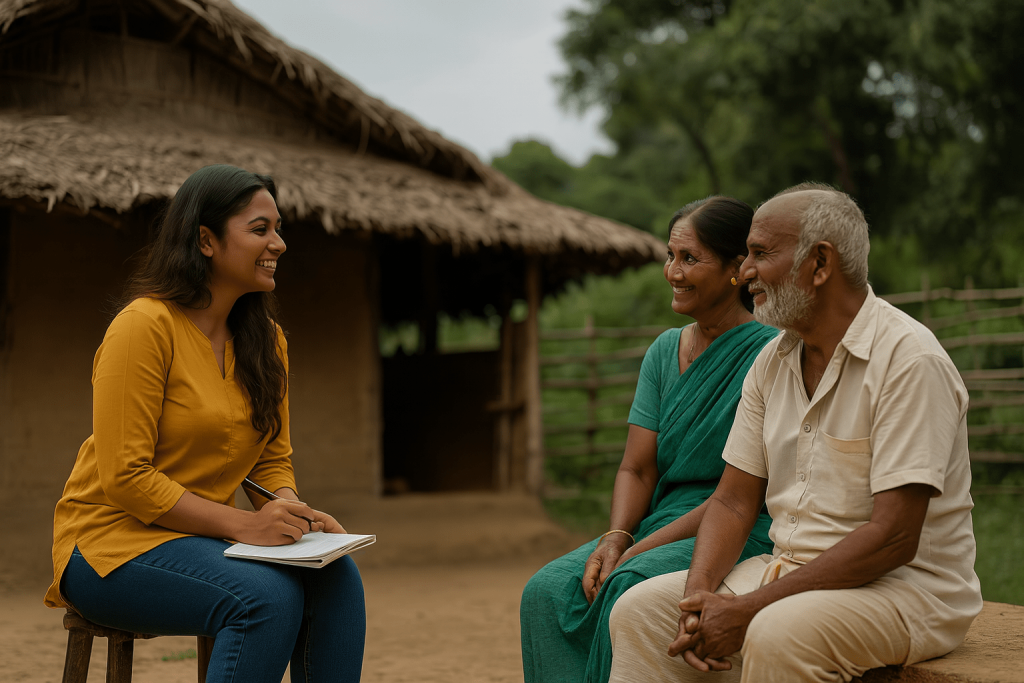
Staying with the villagers, interacting, eating and, praying with them, I have understood their active emotional quotient towards nature.

Post fellowship, I got an opportunity to work in Arunachal Pradesh—a state oozing out diversity in terms of geography, societal norms, and trade and commerce. An adrenaline rush it was! I was overwhelmed that I could explore that place not as a tourist but as a researcher. In a field visit to Lazu, a village adjacent to the Myanmar border, I met a person called Ranjan (name changed). He shared that their survival is directly dependent on Bamboo. Often, they cut it, but there is a season in which they don’t touch it. It is to provide space for Bamboos to grow. Neither they use pesticides nor modified crop cultivation. They practice indigenous farming that best suits their climate, geography, and demography. I believe that if we can amplify this kind of practice and promote it on the global platform that can create a ripple effect on the world, which can make some significant mindset shift.

During my tenure, I have visited many villages and have met many more Ranjans. Staying with the villagers, interacting, eating and, praying with them, I have understood their active emotional quotient towards nature. These experiences over a year took me to a stage where I started questioning the concept of sustainability and development. I wondered what they meant. But only wondering is of no use. To understand and find my answers, I have joined the Indian School of Development Management (ISDM).

ISDM has made me realize two things: first, our knowledge base about people and their interactions is still very inadequate in nature; second, each person has tremendous potential. She or he alone can influence the lives of others within the communities and countries. Precisely, this place helps me to put together two things: my interest in management, and learning gained from both the corporate and the rural communities. I believe learning and insights from both the worlds have enabled me to become more sensitive and deploy a customized integrative approach to achieve targets and design appropriate interventions.

By Debabrata Saha, a student of 2019-20 batch of PGP in Development Leadership at ISDM

Author(s) :

Debabrata Saha

Yes

Get in touch with authors

No ratings yet

Rate this article

Yes

Key topics

Rural Development and Agriculture, Social Justice, Philanthropy and Human Rights

Also found in

Share

Join Our Newsletter

Explore More Articles

Paper / Report

Rethinking Impact: From Metrics to Meaning – Convening Report

How do we move beyond measuring impact as a reporting requirement to using it as a tool for learning, decision-making, and long-term change? This report captures the key discussions, insights, and emerging ideas from Rethinking Impact: From Metrics to Meaning, a convening that brought together funders, practitioners, researchers, evaluators, and development professionals to examine the future of impact measurement in India. Anchored around the launch of the Rural Development Impact Framework (RDIF) and the Development Management–Social Impact Measurement and Management (DM-SIMM) approach, the convening explored how the sector can better understand contribution, centre community perspectives, align funding with the realities of social change, and create measurement practices that support learning over compliance. The report synthesises the conversations, key takeaways, and actions that can help build a more thoughtful and effective approach to understanding impact.
Blog

Development Management: Genesis, Rationale, and the Foundations of an Emerging Discipline

Development Management (DM) arises at a junction that neither development studies nor mainstream management fully occupies on its own. Development thinking has traditionally concerned itself with what change is desirable and for whom, while management thinking has concerned itself with how collective effort gets organised and executed.
Paper / Report

A Methodological Framework for Assessing the Long-Term Impact of a Nonprofit’s Work in a Geography

This report presents the Rural Development Impact Framework (RDIF), a methodological approach for assessing the long-term impact of nonprofit organisations working within a geography. Drawing on realist evaluation, the framework shifts the focus from short-term, project-level attribution to understanding how sustained organisational engagement contributes to social change over time. Using PRADAN’s work in Gumla (Jharkhand) and Dhamtari (Chhattisgarh) as case studies, the research combines qualitative, quantitative, and geospatial methods to examine how interventions interact with local contexts to generate change. The study demonstrates that long-term impact emerges through the cumulative strengthening of livelihoods, institutions, collective agency, and governance systems, offering a practical framework for evaluating organisational contribution to rural transformation.
Paper / Report

DM-SIMM: A Funder’s Guide to Reflect, Learn, and Act on Social Impact

Across the social sector, impact measurement is often reduced to reporting numbers, meeting donor requirements, and proving results. In the process, opportunities for learning, adaptation, and meaningful decision-making are frequently lost. This guide explores how funders can rethink Social Impact Measurement and Management (SIMM) to prioritise continuous learning over compliance. Drawing on research, practitioner insights, and real-world examples, it offers practical ways to make measurement more useful, participatory, and responsive to the realities of implementation. The guide highlights the critical role of funders in shaping incentives, creating space for reflection, and enabling organisations to act on evidence. Ultimately, it presents a vision of impact practice that helps organisations learn, adapt, and stay focused on the change they seek to create.
We use essential and analytics cookies to operate this website and understand how visitors interact with it. As this site also functions as a login identity provider (IDP) for other ISDM portals, some cookies are necessary to enable secure authentication. By continuing to use this site, you consent to our use of cookies.