

Tribal Lifestyle is Threatened By Development

This post examines how rapid development activities pose risks to traditional tribal lifestyles. It explores the cultural, social, and economic impacts of modernization on indigenous communities and urges the adoption of inclusive development policies. The article argues for sustainable and culturally sensitive interventions that empower tribal populations while preserving their unique heritage and social fabric.

A simple gift of hospitality prompted Mridul Upadhyay, 26, a Commonwealth Correspondent from New Delhi in India, to consider how small minorities are affected by the pressures of global demand and development.

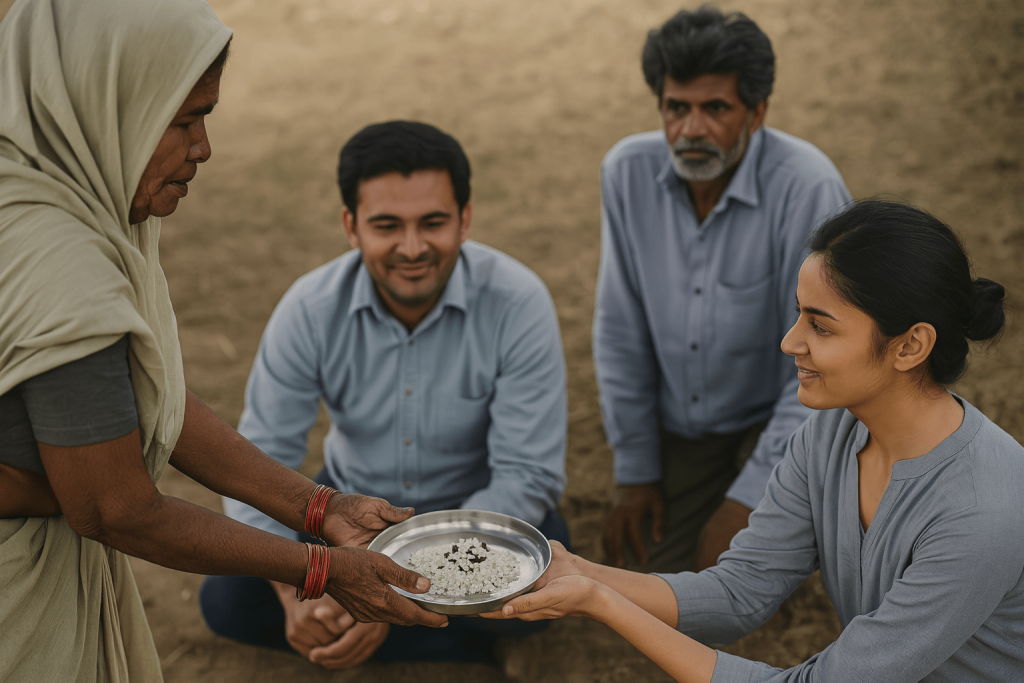
What was the best thing offered to you to eat, as a gesture of hospitality, when you visited someone’s home? For me it was clove, a spice, offered by an old tribal woman in an Indian rural village.

Maybe it was one of the costliest or most special things available in the house to offer, or it’s their culture to offer such things to the guests. But as I learned later, it was not grown or collected, rather purchased by family.

The East India company brought clove from its native home in Indonesia to the Company’s spices gardens in India in 1800 AD. How, then, did offering it become a part of a tribal family’s mode of hospitality?

In this village, the people settled when displaced during construction of a big dam two decades ago. Currently, some 70 families have made their huts, kuccha houses and farms here. They eventually got power connections, but fetching water is still a big issue. Now, because of construction of a highway and some cement factories, the land price has increased here. So the administration, maybe in pressure from businessmen or maybe acting in anticipation of more development, is trying to displace them again. It is not letting these tribal people stay on this land, as these people don’t hold the property rights to the land.

These people, once landowners, got money when their lands were supposed to be submerged in the water of the dam. People spent most of it in transporting whatever they had. For some, there was no guidance on what to do with so much money and no help in reinvestment. Soon they lost the money and land both.

Demand and supply based globalisation has also had negative effect on these minorities by affecting their choices to grow, eat and get things in market.

Previously, they used to grow and have a seven to eight grain meal, but now they are growing, getting and eating rice and wheat-based staple food mostly, which has led many families to malnutrition.

India has over 105 million tribal people, which constitute nearly nine per cent of India’s total population. Tribal people were the native inhabitants of the land in India, before Aryans settled approximately 5000 years ago and sent tribal people to deep jungles. Their culture, religion, tradition and food are still very different.

Aryans brought their religion, and while making Indian constitution in 1949, tribal people were subsumed in the Hindu religion. Previous social interaction with Hindu religion had diffused the caste system among the tribal people and constitutional process increased such forced interaction. Tribal people had been living in small groups with their local governance and rules, so there is no political unity for them to challenge strong national parties. They also faced discrimination that put them in low caste Hindu category.

Tribal peoples read in secular government run schools, are sometimes taught communist philosophy in workshops, are approached by Christian missionaries – and then at home they are tribal. They are confused about what religion or philosophy to follow. They are never trained in keeping their own culture alive, which is perfect in their own imperfections. They are forgetting their rituals, festivals, traditional food and practices and following the majority around them.

In the constitution, India gave freedom of worship and following religion, but what if the minority is getting influenced by majority religion and culture, in an environment that offers them no cultural protection? It might not sound like atrocity crimes or genocide, but it’s a slow, systematic and unnoticed death of diverse cultures.

These are the poorest of the poor and the most marginalised of the marginalised. Can one answer if they ask why and whom to vote in elections? Who cares for such minorities of just 70 families in those rural villages? What are we doing in the name of globalisation, development, economy, super power, consumerism and personal comfort? Are the developed not developing by crushing not just the dreams but also the lives of the so-called undeveloped? Have we really set our priorities perfectly and thoughtfully?

Overwhelmed by all these thoughts, I kept that clove in the pocket of my shirt, close to my heart.

Author(s) :

Admin

Yes

Get in touch with authors

No ratings yet

Rate this article

Yes

Key topics

Indigenous Communities and Tribal Rights, Social Justice, Philanthropy and Human Rights

Also found in

Share

Join Our Newsletter

Explore More Articles

Paper / Report

Rethinking Impact: From Metrics to Meaning – Convening Report

How do we move beyond measuring impact as a reporting requirement to using it as a tool for learning, decision-making, and long-term change? This report captures the key discussions, insights, and emerging ideas from Rethinking Impact: From Metrics to Meaning, a convening that brought together funders, practitioners, researchers, evaluators, and development professionals to examine the future of impact measurement in India. Anchored around the launch of the Rural Development Impact Framework (RDIF) and the Development Management–Social Impact Measurement and Management (DM-SIMM) approach, the convening explored how the sector can better understand contribution, centre community perspectives, align funding with the realities of social change, and create measurement practices that support learning over compliance. The report synthesises the conversations, key takeaways, and actions that can help build a more thoughtful and effective approach to understanding impact.
Blog

Development Management: Genesis, Rationale, and the Foundations of an Emerging Discipline

Development Management (DM) arises at a junction that neither development studies nor mainstream management fully occupies on its own. Development thinking has traditionally concerned itself with what change is desirable and for whom, while management thinking has concerned itself with how collective effort gets organised and executed.
Paper / Report

A Methodological Framework for Assessing the Long-Term Impact of a Nonprofit’s Work in a Geography

This report presents the Rural Development Impact Framework (RDIF), a methodological approach for assessing the long-term impact of nonprofit organisations working within a geography. Drawing on realist evaluation, the framework shifts the focus from short-term, project-level attribution to understanding how sustained organisational engagement contributes to social change over time. Using PRADAN’s work in Gumla (Jharkhand) and Dhamtari (Chhattisgarh) as case studies, the research combines qualitative, quantitative, and geospatial methods to examine how interventions interact with local contexts to generate change. The study demonstrates that long-term impact emerges through the cumulative strengthening of livelihoods, institutions, collective agency, and governance systems, offering a practical framework for evaluating organisational contribution to rural transformation.
Paper / Report

DM-SIMM: A Funder’s Guide to Reflect, Learn, and Act on Social Impact

Across the social sector, impact measurement is often reduced to reporting numbers, meeting donor requirements, and proving results. In the process, opportunities for learning, adaptation, and meaningful decision-making are frequently lost. This guide explores how funders can rethink Social Impact Measurement and Management (SIMM) to prioritise continuous learning over compliance. Drawing on research, practitioner insights, and real-world examples, it offers practical ways to make measurement more useful, participatory, and responsive to the realities of implementation. The guide highlights the critical role of funders in shaping incentives, creating space for reflection, and enabling organisations to act on evidence. Ultimately, it presents a vision of impact practice that helps organisations learn, adapt, and stay focused on the change they seek to create.
We use essential and analytics cookies to operate this website and understand how visitors interact with it. As this site also functions as a login identity provider (IDP) for other ISDM portals, some cookies are necessary to enable secure authentication. By continuing to use this site, you consent to our use of cookies.