

Shubhalaxmi Dalvi is a student of ISDM’s Post-Graduate Program in Development Management. During the rural immersion part of the program called ”Realising India”, she went to a remote village in Banswara District, Rajasthan and documented the story of a woman employed in the age-old craft of making bamboo baskets with nobody to inherit their history and legacy.
A middle-aged woman works with her husband with bare minimum resources and no shed to cover their heads in the October heat. You might think this is a scene from a period film or a story from decades ago, but this is *Kesari’s reality in a remote village in Banswara District, Rajasthan.
Kesari belongs to the Bansphod (name derived from bamboo) community. She has been weaving bamboo baskets with her parents and later with her husband since she can remember. For the past 30-years, Kesari has been coming to the same place to work and sell the baskets she makes. As is the case in the handicraft business, income is not stable. While certain days end with earnings worth Rs 2000/-, sometimes products go unsold for days at a time.
With this income, Kesari and her husband are educating their son, in the hopes that he would have a better future than they had. The word Banswara comes from Raja Banksia who was famous for bamboo ”bans”. The region is losing its traditional art and its importance in modern times. Kesari shared that once, this land was known for its bamboo, but now the people whose livelihood depended on it can hardly make a living. “Humein market lagne par yaha se bhaga dete hai, bade dukan ke stall lagati hai sarkar par hamare liye kuch nahi hai” she said sadly. (They run us away from the spot whenever the market is set up, only the bigger stores get some space to set up their stalls. The government doesn’t do anything for us.)
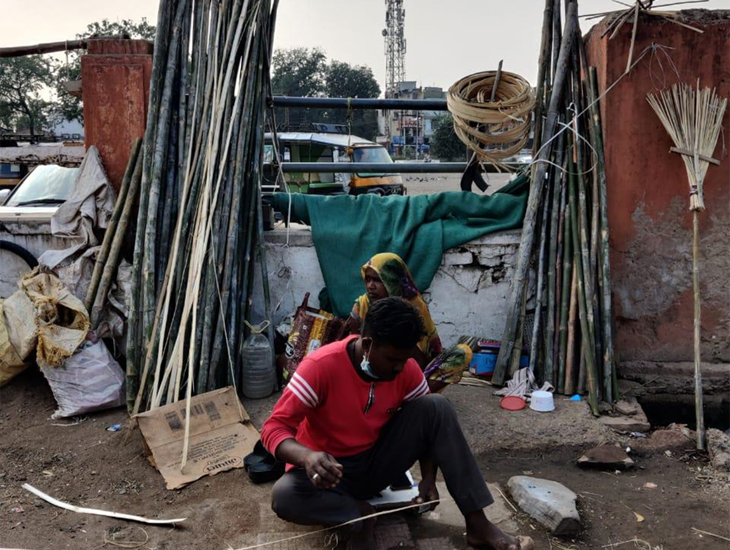
An artisan making Bamboo Baskets in Banswara
Kesari and her husband don’t have larger-than-life expectations. Their only hope is that they should be allotted a permanent spot to sell their wares instead of having to move around and offer bribes in order to secure a spot. They are willing to make do with not obtaining a spot to sell their baskets, but the least they expect is to peacefully work on the streets and attempt to make a living. There used to be a haat system earlier, but it has given way to new trends and demands. Kesari feels the government should acknowledge their existence in society and make schemes that benefit them. While they receive subsidies to buy bamboo, it is insufficient as it is given only once in three years. Kesari wondered aloud, “Sarkar kaise sochthi hai ki hum ispe 3 saal nikal le, sarkari aspatal mein ilaj nai hota toh private jaate hai. Karcha badhta hai par kya kare aur koi chara bhi to nai hai.(How does the government think that we can spend three years on this? When we don’t get treated in government hospitals, we have to go to private ones. The expenses keep rising but we seem to have no alternatives)” They want recognition for their work. The tribal art is dying without government support and to make things worse, the younger generation does not want to continue the craft.
Kesari enjoys the work and is satisfied with what she does through the hardship but also adds, “Acchi cheez change aur suvidha milne main kya hi bura hai. Main bhi apne bacche ko mere kaam se accha bhavishya dena chahti hun. Aur agar main sarkar se madad ki apeksha rakhu to kya ye galat hai? (What’s wrong with getting some comforts? I want my children to have a better future than me. If I want some help from the government for this, what is wrong with that?”)
This conversation with Kesari left me thinking, “Is it wrong to expect a better standard of living and help from the government that was made for the people and by the people?”


