

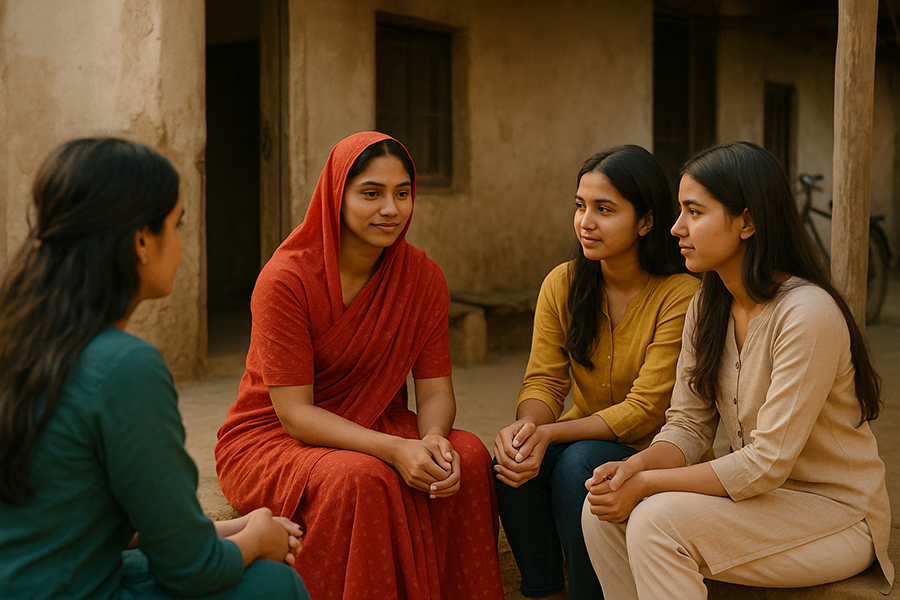
Amidst the diverse, beautiful colors of food, attire, and landscape with its variety of flora and fauna lie several harsh realities that hold back the district of Pali. Bestowed with rich heritage and abundant natural resources, Pali is a rural district in Rajasthan. A grave concern in this district is the lack of adequate educational opportunities for women and their status in society. The situation is worse for those from marginalized communities in villages.
A Beacon of Inspiration
Priti* (21) belongs to the Keer community, a marginalized community in Dudhani village of Bali tehsil in Pali. I met her during my team’s interactions with her community members, where she played the role of a guide. Through the immersion experiences, I learned her story and realized that it was nothing short of an inspiration to her community.
A Glimpse into Regressive Customs
Pali, generally, is a patriarchal and caste-sensitive society, and girls and women do not have access to educational opportunities with prevalent cases of child marriages and regressive customs like bride selling. The district witnesses high dropout rates among young girls after completing primary education due to fewer senior secondary schools and colleges in restricted areas that are situated far away from their homes and for which they do not get permission from their family. Priti’s community, not unlike other rural parts of Pali, is highly patriarchal, where women are mostly confined to the four walls of their homes and considered nothing more than a commodity.
Encountering Regressive Customs
During my visit and interactions, I found Pali mired in varied regressive and unusual traditional customs such as Nata 1 (bride-selling), Aata-Saata2 (exchange of women for marriage between two families), etc. shackle women in these communities. My journey during this immersion was replete with good personal encounters indicating the considerable gap between men’s and women’s rights from their access to fundamental rights (which of these rights in particular?) to having the agency to make decisions for their futures.
Breaking the Chains
Like other girls in her community, Priti faced multiple challenges completing her education and pursuing her dreams. She struggled against family opposition to study until the 8th standard and finally dropped out when her father’s opposition grew more assertive. She belonged to a lower caste which didn’t win her favours since they lived in a caste-dominated society.
A disheartened Priti was forced to take a year-long break. She discovered Doosra Dashak, a social purpose organisation (SPO) in Pali that primarily teaches holistic education to adolescents, especially females aged 11-20 years.
Empowered by Education
Priti jumped at this opportunity, raising her concerns with the founder. As a response, he tried to convince her father and family to permit her to pursue her dreams. This conversation didn’t go well, unable to garner much support. Nevertheless, Priti took a bold decision, went against her father’s wishes, and joined back with backing from the SPO. To keep her father happy, she supported him in agricultural work to generate adequate income for their family while continuing and working hard in school. This was just the beginning as Priti decided to join the Bachelor of Arts programme in a nearby gain without family support. Commuting 1 km on foot every day to catch a bus to her college, Priti continues this physically exhausting and mentally draining journey to make her dream come true. The absence of higher education institutes in the village and proper conveyance to the city hinders more women from pursuing further education, despite their potential and interest.
The Transformative Power of Education
Priti’s confidence and self-esteem were greatly benefited by the various training sessions in Doosra Dashak on holistic education, fundamental rights awareness, convincingly voicing one’s opinions, and computer skills. This was evident as she smoothly guided our team interactions and focus group discussions with female MGNREGA3 workers and men engaged in other activities from communities different from her own.
A Beacon for Change
Currently, Priti is also associated with a rural development society RAJEEVIKA4 that implements self-help groups (SHGs). She trains and educates women from the village community about their rights, divides caused by gender, caste, class, and employment opportunities. Further, she motivates them towards becoming economically and mentally independent in life. Priti could have continued to focus on her journey of becoming empowered, but she truly wants to make a difference for the girls and women in her community.
She is working on a large-scale project to kick-off a bus service in her village Dudhani to facilitate an easy and safe commute, especially for girls who wish to pursue higher education outside the city. Further, she promotes cottage-based industries to boost livelihood and income opportunities for village women. In addition, Priti leads six other SHGs in her village and soon plans to form a Village Level Organisation (VLO), a Gram Sangathan, which would help mobilize all women from the community and motivate them to participate actively. To work together in unity towards promoting quality education, skilling for better livelihood opportunities, and overall empowerment.
Vision for the Future
Priti dreams of becoming her best version and giving back to society by working more towards the empowerment of rural girls and women in Pali, a much-needed area to be emphasized that could immensely boost the overall development of the district. With steadfast determination to pursue her goals, Priti continues to be a role model for other females from the village community to question deep-rooted regressive norms and take a stand for themselves towards leading a better life.
According to her, “It is high time that people of Pali give females their well-deserved status, and small positive changes contribute to larger impacts. I am doing the same by bringing a positive shift and generating awareness about the suitable means. Also, if girls and women are educated and independent, it is beneficial for not only their families but contributes towards the development of the society and the nation as well.” *All names have been changed to protect identities
Empowering Through Education
In the tapestry of Pali’s societal norms, Priti emerges as a vibrant thread, weaving a narrative of resilience, determination, and empowerment. Her story epitomizes the challenges faced by many women in rural India, yet it also illuminates the transformative power of education and individual agency. As we unravel the layers of Priti’s journey, we uncover not just a personal triumph but a catalyst for societal change.
Nurturing Changemakers
Aishwarya Srivastava, through the Realising India program at ISDM, unearthed the inspirational story of Priti, showcasing how education and determination can defy societal constraints. This narrative reflects ISDM’s commitment to nurturing changemakers who understand the intricacies of India’s developmental challenges and work towards sustainable, community-driven solutions.
Realising India is a two-week structured immersion program planned for the students between Terms II and III as part of ISDM’s Context-Based Collaborative Learning (CBCL). It enables the students to develop a deep understanding of people’s lives on the district level, preparing them to design interventions.
1. Practiced by the Bhil tribe, one of the largest in South Asia, Nata Pratha is a centuries-old custom still alive in several Indian states like Rajasthan, Gujarat, and Madhya Pradesh. It allows men to live with as many women resulting in children being abandoned by their parents. Traditionally, both the man and the woman are supposed to be married or widowed, but the custom has evolved to include single people as well. People have started misusing the Nata custom.
2. Aata saata is a system where a family that enters into an alliance of their daughter only when the other family pledges to give them a daughter to be married in their family
3. The Mahatma Gandhi Rural Employment Act (MGNREGA) is regarded as the Indian labor law and social security measure that targets to guarantee people of India the ‘right to work.
4. Information about RAJEEVIKA (is this http://www.rajeevika.rajasthan.gov.in/about-rgavp.php?)


