

Navigating the Labyrinth of Rajasthan’s Healthcare
In the vast expanse of Rajasthan, where the vibrant hues of culture blend with the arid landscapes, lies a healthcare narrative that mirrors the broader challenges faced by India. In the pursuit of ‘Realizing India,’ a cohort from the Indian School of Development Management (ISDM), including myself, delved into the heart of Alwar to unearth the ground realities of the healthcare system. This exploration goes beyond statistics, uncovering the lived experiences that underline the existing disparities in healthcare accessibility.
Insights into Rajasthan’s Healthcare Reality
As we embark on this journey through the corridors of Rajasthan’s healthcare system, expect to unravel more than just statistics and figures. The upcoming sections delve into the poignant stories that breathe life into the healthcare conundrum faced by the people of Alwar. From the challenges of an elderly woman seeking medical attention to the struggles of children with mental disabilities and the perilous journeys of pregnant women, this blog navigates through the heart-wrenching realities that statistics often fail to capture.
Perception vs. Reality: Rajasthan’s Healthcare Dilemma
Rajasthan, with its majestic palaces, rich heritage, and vibrant culture, often paints a picture of grandeur. However, beneath this tapestry of beauty lies a stark contrast—a healthcare system grappling with accessibility and quality. The commonly held perception of Rajasthan as a cultural gem clashes with the reality faced by its residents, especially in remote areas like Alwar. By unraveling this incongruity, we aim to bridge the gap between the perceived and lived experiences of healthcare in this region.
The Urban Conundrum: Quality vs. Proximity
The urban-centric nature of healthcare services in India sets the stage for a complex narrative. In many towns, including my own, the proximity of medical facilities often comes at the cost of compromised quality. District hospitals, while financially accessible, raise concerns about the standard of healthcare provided. However, for those residing in rural landscapes, the challenges are exponentially magnified. Drawing from personal experiences in a West Bengal village, where the closest medical help was over 30 kilometers away, the stark reality emerges – basic healthcare becomes a costly and distant luxury.
India’s Healthcare Quandary: A Question of Quality and Access
A critical metric for assessing a nation’s development is the accessibility and quality of its healthcare. Unfortunately, India lags in this aspect, with only 20 doctors and nine hospital beds available per 10,000 people. To dissect these challenges at the grassroots level, our ISDM cohort embarked on a journey to Alwar, Rajasthan, a region that has witnessed incremental improvements in public health services over the last decade. Despite progress, the current infrastructure remains insufficient for the needs of the population.
Unveiling Alwar’s Healthcare Challenges
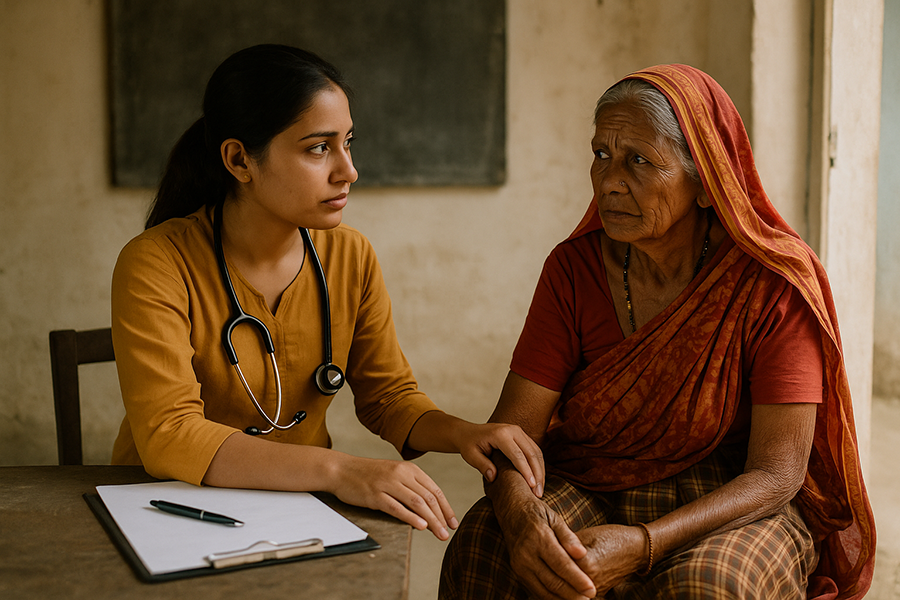
Traversing the landscapes of Alwar, the intricate tapestry of healthcare challenges begins to unfold. An encounter with an elderly woman on a bus to Jhiri village epitomizes the struggles faced by the locals. She narrates her futile visit to a Primary Health Centre (PHC), devoid of a doctor. Hours later, she departs without consultation, racing against time to catch the last bus. This incident becomes a microcosm of the larger healthcare plight in Alwar.
A Consequence of Limited Awareness
A significant number of rural inhabitants in Alwar turn to private health facilities, driven by low awareness, particularly concerning mental health issues impacting children’s education. The lack of awareness and facilities in communities and health institutions places children with mental disabilities at constant risk. The narrative unfolds with tales of limited treatment options, amplifying the vulnerability of these children.
A Perilous Journey
Maternal health emerges as a focal point of concern, with 1.6% of deliveries in Alwar occurring at home due to inadequate medical care and limited transportation options. Instances of pregnant women being shifted to private hospitals over 50 kilometers away due to the absence of medical staff at PHCs reveal the dire consequences of a faltering public healthcare system. Tragically, some pay the ultimate price—mothers and unborn babies losing their lives due to systemic failures.
Mobility-Centric Healthcare
As tales of despair and systemic failures echo through Alwar, a resounding call for a paradigm shift emerges. The conventional population-based healthcare model must evolve into a mobility-centric one. The mere availability of healthcare facilities proves insufficient when limited transport options render them inaccessible to those in remote areas. It is in these far-flung regions that lives are lost due to the unbridgeable gap between healthcare availability and mobility.
From Realization to Action
The stories from Alwar underscore the urgency for transformative action in India’s healthcare landscape. The realization that accessibility extends beyond physical presence to mobility becomes paramount. A mobility-centric model holds the potential to revolutionize healthcare delivery, particularly in remote areas where lives hang in the balance due to inadequate transport options.
Beyond Statistics to Lived Realities
The journey through Alwar reflects a transition from statistics to lived realities. The struggles of an elderly woman on a bus, the challenges of children with mental disabilities, and the perilous journeys of pregnant women are not mere data points but poignant stories that breathe life into the healthcare conundrum. ISDM, through initiatives like ‘Realizing India,’ bridges the gap between numerical indicators and the profound human experiences that define the quest for accessible and quality healthcare.
The ‘Realizing India’ initiative by ISDM transcends the confines of traditional education. It ventures into the heartlands, unraveling narratives that seldom find a place in mainstream discourse. The healthcare revelations from Alwar epitomize ISDM’s commitment to nurturing leaders who grasp the intricacies of India’s developmental challenges. It underscores the need for holistic, community-driven solutions, creating ripples of change that emanate from the grassroots.
As we navigate through the labyrinth of Alwar’s healthcare challenges, it serves as a subtle reminder that the realization of India’s potential lies in the hands of transformative education. ISDM, through its immersive programs, becomes a beacon, guiding the way to a future where healthcare disparities are addressed, and every individual, regardless of geographic location, can access quality medical care. In realizing India’s healthcare potential, ISDM continues to be a catalyst for change, fostering leaders who carry the torch of accessibility, equity, and transformative action.


