
- ISDM reveals false assumptions and skills gap within the Development Management field within the social sector
- With a strong ecosystem lens, ISDM is pioneering pedagogies around development management.
- ISDM is inviting students wanting to pursue careers in Development Management to join their 2018-2019 post-graduate programme here.
Diverging Paths between Business and Social Management
In the last 2 decades, the “Third Sector” or “Development Sector” has grown in terms of the number and size of organisations, available funding, the number of people involved, and influence in government decisions and processes.
While the intentions are noble, management in this newly burgeoning sector has hewed to the same principles that have governed capitalistic establishments. There has been a profound lack of understanding of the differences in the business and development sector and a serious under-estimation of the complexity and effort required to drive social change.
Today, a growing number of youngsters have made a choice to have a career in social sector. Sadly, the only option for these students to become technically qualified is by studying for an MSW, MA Development, or Management Courses like MBA or an MPA (Public Administration). None of these really prepare them for a career in Development Management to build strong, scalable, sustainable organisations.
Bridging Gaps by Driving ‘Development Management’
Indian School of Development Management (ISDM) is a pioneering institution built on the back of collective wisdom and collective philanthropy to address this critical gap. Having analyzed the landscape of work being done in Development Management – it became evident that the dominant narrative suggests that the Development Sector needs to learn and adopt Business Management Practices, and manage organisations in this sector the way Corporate Sector is run.
This idea is problematic as it assumes that the fundamental axioms that Business Management was built i.e. Industrial Revolution and Capitalism are equally relevant for the social sector. If any, to quote Jacinda Ardern, the recently elected Prime Minister of New Zealand, capitalism is a blatant failure for leaving millions homeless and in deep poverty.
ISDM has set itself an objective to study and define what Development Management really is. The study of management practices that are relevant for organisations in the development sector will explore what it takes to make the right decisions, manage resources, develop institutionalized and widely available knowledge, and more.
Today, ISDM has developed a first of its kind curriculum and pedagogy that is best suited for students wanting to prepare for careers in Development Management.
The first full cohort of 60 passionate students from across the country, representing 19 states, are part of the flagship 1-year Post Graduate Program in Development Leadership. With students on 100% scholarship, they can choose careers in Domestic and International NGOs, Foundations and Funding Organisations, CSR and Corporate Philanthropy Teams, Think Tanks, Social Enterprises and also start their own ‘for-impact’ organisations.
This batch graduates in June 2018 and the early admissions for the next batch of this increasingly coveted program commencing in July 2018 has begun recently.
However, ISDM has recognized that developing a PG Program and having a batch of passionate and capable students graduating are not enough.
Adopting a Systemic Approach to Development Management
There is a need to work on the whole ecosystem to influence how the sector adopts Development Management ideas and professionals. Towards this, ISDM is working on various parts of the ecosystem: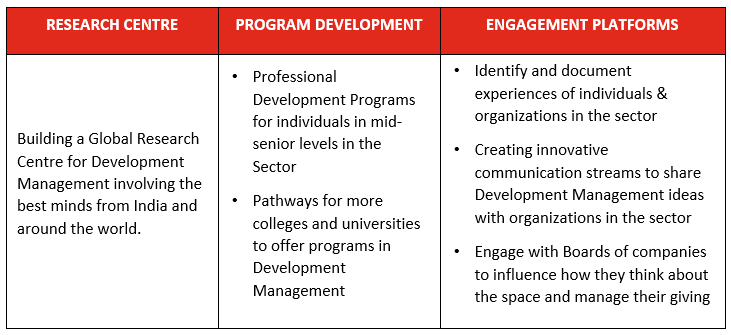
Building leadership and management talent for the sector is very critical and has been recognized and commented extensively in recent reports by and more.
What is required is investment in building, articulating and demonstrating an understanding of what it takes to lead and manage organisations in the sector. The billions of dollars being spent in the sector will have a far bigger and sustainable impact if we can collectively achieve the objectives ISDM has set for itself.
AVPN is proud to have ISDM as one of its members and id delighted with the collaborative efforts of ISDM towards developing a catalytic environment for Development Management. ISDM has been working with numerous individuals and organisations working in the sector notably several of whom are AVPN Members like CSF, Edelgive Foundation, STiR Education, Magic Bus, Dasra, J-PAL, and Villgro. Anyone interested in the work of ISDM and would like to engage in their drive for collective wisdom and collective philanthropy should reach out to Gaurav Shah, one of the Founders of ISDM at gaurav.shah@isdm.org.in


