
My Idea: Development Was Pretty Underdeveloped

In this reflective piece, the author critiques traditional development practices, labeling them as “underdeveloped.” The article challenges conventional models and calls for reimagined strategies that incorporate innovation, inclusivity, and adaptive learning. By sharing personal insights and practical recommendations, it advocates for a more dynamic and responsive approach to development management that truly addresses societal needs in a rapidly changing world.

“If you do what you have always done, you will get what you have always gotten.”  – Tony Robbins

“There are times where the greatest change needed is the change of your viewpoint.” – Denis Diderot.

The blog talks about my personal experience in the development sector and how the experience unfolded my quest to go deeper and question my understanding of life.

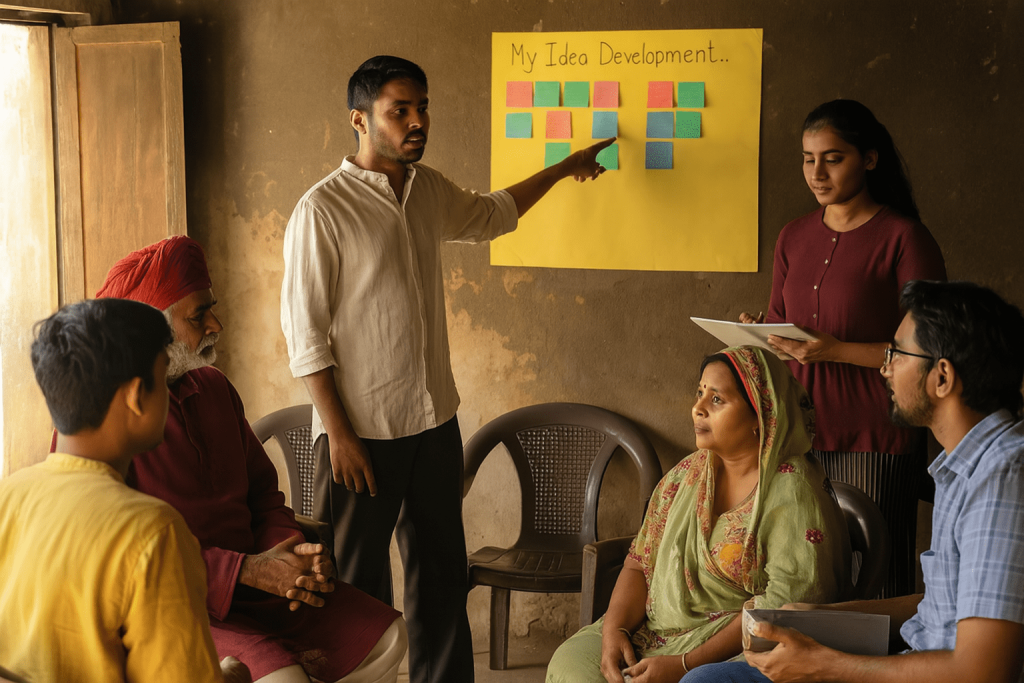
I had an experience where I had an intention to digitally empower the villagers of Parol, a village on the outskirts of Mumbai. I thought I was privileged to have the power of the internet, which also helped me create opportunities for villagers. I wanted villagers to utilise this power in a positive way and help others around them. 

How does it feel when you take an action thinking that it is 100% correct and it turns out to be the exact opposite? I wanted to bridge the digital gap between rural and urban India. I left no stone unturned to make that happen, but in the process, I learned that I wanted the villagers to reach where I was then because I thought I was better off.  

But am I better off? Do they actually need this shift? Aren’t they happier than I am? Was I doing it for my own satisfaction or for the betterment of the community? Somewhere between these questions, I got my answer. I knew I was not right, even though my intentions were good.  My idea of development was underdeveloped. 

I, therefore, landed at the Indian School of Development Management to broaden my perspective and understanding of this space. It has been just a month here and I am questioning my whole idea of development. 

Compassion, values and principles, sustainability, creating an agency, systemic approach, collaboration, working with and not for the community, shared vision, the meaning of growth, environmental boundaries, and regeneration were not even near my idea of social service. 

My thoughts are changing every day, every moment, I am excited to see how the whole year unfolds for me, I am sure ISDM will not fail to surprise me.

By Shivangi Jasrapuria, student of 2019-20 batch of PGP in Development Leadership at ISDM

Author(s) :

Shivangi Jasrapuria

Yes

Get in touch with authors

No ratings yet

Rate this article

Yes

Key topics

Education and Skill Development, Social Justice, Philanthropy and Human Rights

Also found in

Share

Join Our Newsletter

Explore More Articles

Paper / Report

Rethinking Impact: From Metrics to Meaning – Convening Report

How do we move beyond measuring impact as a reporting requirement to using it as a tool for learning, decision-making, and long-term change? This report captures the key discussions, insights, and emerging ideas from Rethinking Impact: From Metrics to Meaning, a convening that brought together funders, practitioners, researchers, evaluators, and development professionals to examine the future of impact measurement in India. Anchored around the launch of the Rural Development Impact Framework (RDIF) and the Development Management–Social Impact Measurement and Management (DM-SIMM) approach, the convening explored how the sector can better understand contribution, centre community perspectives, align funding with the realities of social change, and create measurement practices that support learning over compliance. The report synthesises the conversations, key takeaways, and actions that can help build a more thoughtful and effective approach to understanding impact.
Blog

Development Management: Genesis, Rationale, and the Foundations of an Emerging Discipline

Development Management (DM) arises at a junction that neither development studies nor mainstream management fully occupies on its own. Development thinking has traditionally concerned itself with what change is desirable and for whom, while management thinking has concerned itself with how collective effort gets organised and executed.
Paper / Report

A Methodological Framework for Assessing the Long-Term Impact of a Nonprofit’s Work in a Geography

This report presents the Rural Development Impact Framework (RDIF), a methodological approach for assessing the long-term impact of nonprofit organisations working within a geography. Drawing on realist evaluation, the framework shifts the focus from short-term, project-level attribution to understanding how sustained organisational engagement contributes to social change over time. Using PRADAN’s work in Gumla (Jharkhand) and Dhamtari (Chhattisgarh) as case studies, the research combines qualitative, quantitative, and geospatial methods to examine how interventions interact with local contexts to generate change. The study demonstrates that long-term impact emerges through the cumulative strengthening of livelihoods, institutions, collective agency, and governance systems, offering a practical framework for evaluating organisational contribution to rural transformation.
Paper / Report

DM-SIMM: A Funder’s Guide to Reflect, Learn, and Act on Social Impact

Across the social sector, impact measurement is often reduced to reporting numbers, meeting donor requirements, and proving results. In the process, opportunities for learning, adaptation, and meaningful decision-making are frequently lost. This guide explores how funders can rethink Social Impact Measurement and Management (SIMM) to prioritise continuous learning over compliance. Drawing on research, practitioner insights, and real-world examples, it offers practical ways to make measurement more useful, participatory, and responsive to the realities of implementation. The guide highlights the critical role of funders in shaping incentives, creating space for reflection, and enabling organisations to act on evidence. Ultimately, it presents a vision of impact practice that helps organisations learn, adapt, and stay focused on the change they seek to create.
We use essential and analytics cookies to operate this website and understand how visitors interact with it. As this site also functions as a login identity provider (IDP) for other ISDM portals, some cookies are necessary to enable secure authentication. By continuing to use this site, you consent to our use of cookies.