

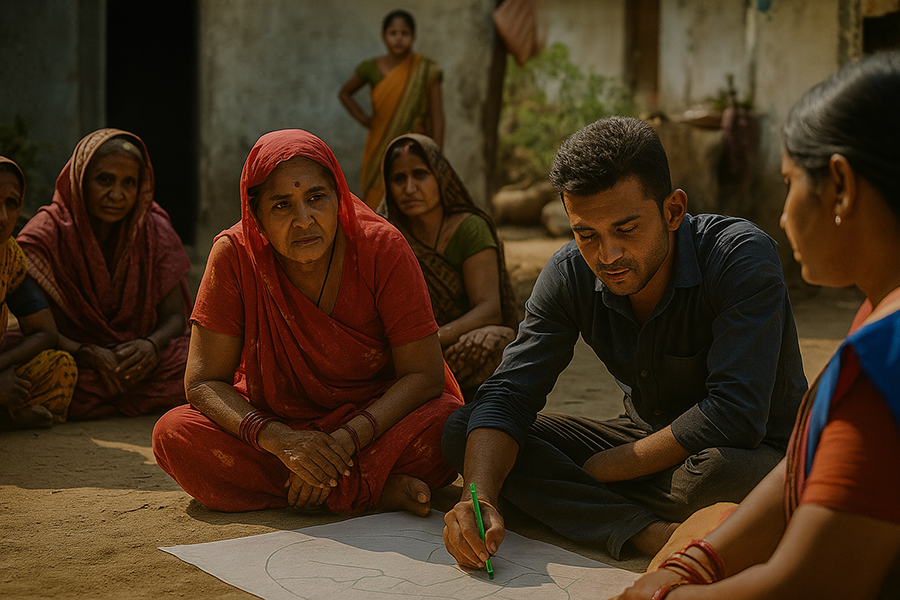
Leading the gram panchayat in a gunghat

Suchananda Roy is a student of ISDM’s Post-Graduate Program in Development Management. During the rural immersion part of the program called ‘Realising India’, she met a strong and bold woman in her sixties who had served as a Sarpanch from 2004 to 2009 in Goth Gram panchayat in Ambah block in Morena. Her story is inspirational because she did this in a highly patriarchal society, where the practice of ‘Sarpanch Pati’ is still prevalent.Shivani*, a dynamic woman, faced backlash from…

Suchananda Roy is a student of ISDM’s Post-Graduate Program in Development Management. During the rural immersion part of the program called ‘Realising India’, she met a strong and bold woman in her sixties who had served as a Sarpanch from 2004 to 2009 in Goth Gram panchayat in Ambah block in Morena. Her story is inspirational because she did this in a highly patriarchal society, where the practice of ‘Sarpanch Pati’ is still prevalent.

Shivani*, a dynamic woman, faced backlash from a male-dominating society when she stood for elections about a decade ago in Ambah block in Morena. According to reports, there is a 17% difference in literacy rates between men and women. However, Shivani’s strong willpower enabled her to serve humanity and uplift the conditions of women in her village. Her determination made her surpass any odds; she did that and came out with flying colours.

Her fearlessness and confidence exuded when she narrated her life story. According to Shivani, the ghungat (a veil to cover her head) is obligatory for every bride since societal custom dictates it. Though she wore the ghunghat, she didn’t allow it to stop her tremendous ambitions to bring change to society. She believed change could only occur when a woman in her home started a conversation with her family. Even though, as Development Management programme students, we had been taught about gender equality, it was something else altogether watching Shivani practice it.

Fifteen years ago, societal pressures shackled Shivani but not her vision. She was a one-woman army when it came to working for the development of people and her village. I imagined how difficult it was for her to be in a position to govern the system while facing humiliation from her society. Even today, the concept of ‘Sarpanch-pati’ prevails in the district. In one of the Gram Sabha meetings that I attended, the Sarpanch, a woman, was not present. Her husband represented her in the Gram Sabha proceedings. More than ten years ago, Shivani overcame the same bias through sheer perseverance, and soon people recognised her sincere efforts and respected her.
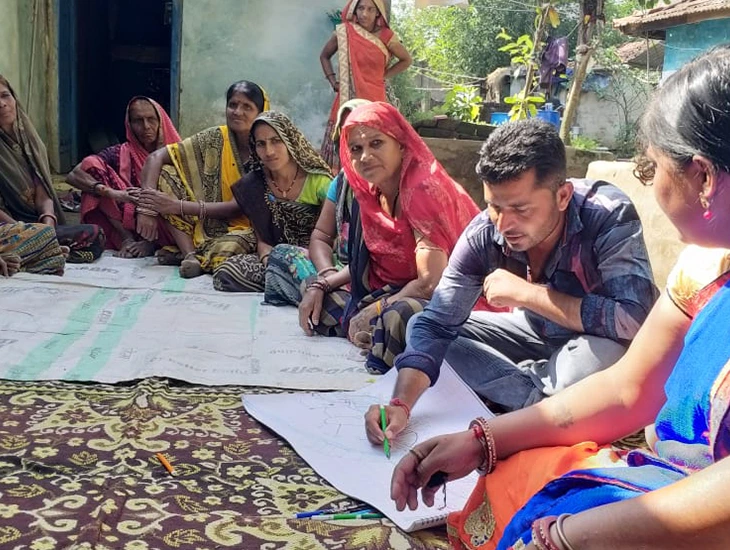
Still from a Gram Sabha meeting in Morena.

Shivani’s model village began inspiring surrounding villages facing similar challenges. Despite prevalent patriarchal norms, she not only stood for local elections but ended up becoming the first female head of her village panchayat. Adding a feather to her hat, she won the award of ‘Adarsh Gram Panchayat’ during her tenure. She received many such awards during her term from various levels of government.

During our conversation, Shivani mentioned how she was proactive in building water resources so that no woman would have to walk several kilometres to get the same. She even went to the teacher’s home and asked why they were not in school during teaching hours in case of uninformed teacher absenteeism, which shows how she was concerned with the children’s education. She shared that while she didn’t get the opportunity to study beyond class ten, she wanted to ensure that this should not happen with other children due to a lack of infrastructure.

During her tenure, Shivani continuously raised her voice right from the Gram Sabha to the Chief Minister’s office for building good infrastructure, library, and playground in the school’s vicinity so that no child is left behind and the overall growth of a child can take place. She was determined and sincere towards her idea of developing a village and put all her efforts into making a self-sufficient village.

President Dr A.P.J. Abdul Kalam recognised her efforts, inviting her to the Rashtrapati Bhawan. Inspired by ‘Rani Laxmi Bai’s stories, she remained courageous when working for her people. She said, “Kisi ka dam hai to rokke dikhaye, mai sherni hoon, kabhi har nai manungi”. Due to Shivani’s poor health, she didn’t contest any further elections. However, with her progressing health, her aspirations are back as she aims to become an MLA (Member of Legislative Assembly). She feels that she will not see the envisioned change unless she enters the system.

Shivani is a role model not only to me but many women in her village, and you can see why that is. Her principles give many young people strong notions of how a woman can contribute to society by removing the gender stereotyping roles and bringing gender equality into people’s minds.

If you are considering a career in Social Sector, it might be worth your while to look into PGP -DM program offered by ISDM. You can find more information about the program here:

Suchananda Roy


*All names have been changed to protect identities


Author(s) :

Suchananda Roy

Yes

Get in touch with authors

No ratings yet

Rate this article

Yes

Key topics

Rural Development and Agriculture, Social Justice, Philanthropy and Human Rights

Also found in

Share

Join Our Newsletter

Explore More Articles

Paper / Report

Rethinking Impact: From Metrics to Meaning – Convening Report

How do we move beyond measuring impact as a reporting requirement to using it as a tool for learning, decision-making, and long-term change? This report captures the key discussions, insights, and emerging ideas from Rethinking Impact: From Metrics to Meaning, a convening that brought together funders, practitioners, researchers, evaluators, and development professionals to examine the future of impact measurement in India. Anchored around the launch of the Rural Development Impact Framework (RDIF) and the Development Management–Social Impact Measurement and Management (DM-SIMM) approach, the convening explored how the sector can better understand contribution, centre community perspectives, align funding with the realities of social change, and create measurement practices that support learning over compliance. The report synthesises the conversations, key takeaways, and actions that can help build a more thoughtful and effective approach to understanding impact.
Blog

Development Management: Genesis, Rationale, and the Foundations of an Emerging Discipline

Development Management (DM) arises at a junction that neither development studies nor mainstream management fully occupies on its own. Development thinking has traditionally concerned itself with what change is desirable and for whom, while management thinking has concerned itself with how collective effort gets organised and executed.
Paper / Report

A Methodological Framework for Assessing the Long-Term Impact of a Nonprofit’s Work in a Geography

This report presents the Rural Development Impact Framework (RDIF), a methodological approach for assessing the long-term impact of nonprofit organisations working within a geography. Drawing on realist evaluation, the framework shifts the focus from short-term, project-level attribution to understanding how sustained organisational engagement contributes to social change over time. Using PRADAN’s work in Gumla (Jharkhand) and Dhamtari (Chhattisgarh) as case studies, the research combines qualitative, quantitative, and geospatial methods to examine how interventions interact with local contexts to generate change. The study demonstrates that long-term impact emerges through the cumulative strengthening of livelihoods, institutions, collective agency, and governance systems, offering a practical framework for evaluating organisational contribution to rural transformation.
Paper / Report

DM-SIMM: A Funder’s Guide to Reflect, Learn, and Act on Social Impact

Across the social sector, impact measurement is often reduced to reporting numbers, meeting donor requirements, and proving results. In the process, opportunities for learning, adaptation, and meaningful decision-making are frequently lost. This guide explores how funders can rethink Social Impact Measurement and Management (SIMM) to prioritise continuous learning over compliance. Drawing on research, practitioner insights, and real-world examples, it offers practical ways to make measurement more useful, participatory, and responsive to the realities of implementation. The guide highlights the critical role of funders in shaping incentives, creating space for reflection, and enabling organisations to act on evidence. Ultimately, it presents a vision of impact practice that helps organisations learn, adapt, and stay focused on the change they seek to create.
We use essential and analytics cookies to operate this website and understand how visitors interact with it. As this site also functions as a login identity provider (IDP) for other ISDM portals, some cookies are necessary to enable secure authentication. By continuing to use this site, you consent to our use of cookies.