
How Self Help Groups Generated Awareness on Basic Rights in Bastar

This article explores how self-help groups in Bastar have successfully raised awareness about basic rights among local communities. It details grassroots initiatives that empower marginalized groups, facilitate community mobilization, and foster social inclusion. The narrative highlights the transformative role of localized efforts in promoting civic rights and strengthening social cohesion in underdeveloped areas.

It was a hot March afternoon and the sun was gradually setting, when I reached the village in Chhattisgarh and parked my bike under the shade of a tamarind tree after a long run of 56 kilometres. I sat under the tree to rest and drink some water as the hot, dry weather and the wind had tired me. 

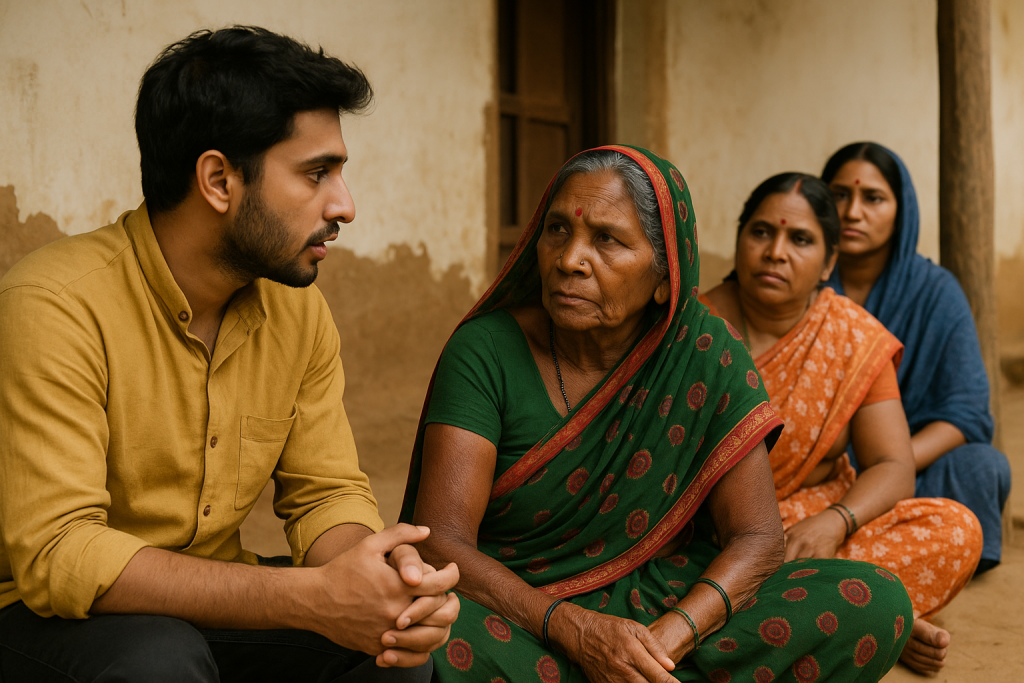
As Bastar is blessed to have plenty of huge and old trees, the cool breeze beneath the tree and one glass of cold water fetched from the waterfall were enough to reduce my fatigue. The village was situated near the forest and villagers were returning from their workplaces. I noticed that women from different self-help groups were gathering there, one by one, for the village organisation (VO) meeting. 

The condition of health indicators among the tribal population in Bastar is not satisfactory. A survey, done in Darbha block (n=528) shows that BMI (Body Mass Index) of 49% of women is below normal and within them, 10% of women have severely low BMI. This is the result of a large number of problems in the system and within the society.

From November 2018, we started initiating discussions in different self-help group meetings, to generate awareness on the rights and entitlements of the community members as Indian citizens. The discussion took place in self-help group level and VO level meetings and occasionally in CLF (Cluster Level Forum) meetings; where we tried to raise awareness in the community. 

Working with the community on maternal and child health in Darbha block of Bastar, we found that most of the Anganwadi Centres were not properly functioning. From February, we started mobilising the community towards approaching the government systems to work in a more effective way and, we facilitated visits to Anganwadi Centres by the women collectives. 37 Anganwadi Centres were identified in that area to initiate visits.

The meeting that was scheduled for that afternoon was a VO level meeting where most of the issues of different self-help groups and the village were to be discussed. That meeting was significant as the Anganwadi workers of the village were present there to seek the support of the community towards providing quality service. When villagers went one step forward, it made the government employees more responsible for service delivery.

I realised and got the essence of the whole scenario after joining ISDM (Indian School of Development Management) and attending different lectures on the constitution, community involvement, and rights and entitlements. Our thought pattern makes us think that it is the responsibility of the government to provide services for the welfare and upliftment of the community. 

The concepts discussed at ISDM made me realise that it is our system, and when it is not properly functioning, it is also our responsibility to make it function properly. The steps that we took in a small village of Bastar gave me hope that one day the health of children would improve and the problems they were continuously facing would be sorted. Earlier, during the discussion within SHGs (self-help groups), we heard a number of complaints against Anganwadi Centres but they were not able to figure out how to solve them. It was not an easy task for the women collectives to raise their voice against the Anganwadi Centre to get effective service. It took a large amount of effort to make them realise that they are paying tax to the government indirectly and getting the services is their right.

Lack of education among women made this process extremely tough and they had to overcome a few obstacles from within themselves, as well as from their families and the community. However, during the closing discussion with them, I realised that providing little knowledge and confidence within them worked as a catalysing factor. Practically, it might not be the only initiative that will change the whole scenario of health in that village, but it is sufficient for the community to feel that they can, and they have the potential to bring about change.

Note: The writer is a student of 2019-20 batch of PGP in Development Leadership at ISDM

Author(s) :

Nilanjan Panda

Yes

Get in touch with authors

No ratings yet

Rate this article

Yes

Key topics

Child Rights and Protection, Social Justice, Philanthropy and Human Rights

Also found in

Share

Join Our Newsletter

Explore More Articles

Paper / Report

Rethinking Impact: From Metrics to Meaning – Convening Report

How do we move beyond measuring impact as a reporting requirement to using it as a tool for learning, decision-making, and long-term change? This report captures the key discussions, insights, and emerging ideas from Rethinking Impact: From Metrics to Meaning, a convening that brought together funders, practitioners, researchers, evaluators, and development professionals to examine the future of impact measurement in India. Anchored around the launch of the Rural Development Impact Framework (RDIF) and the Development Management–Social Impact Measurement and Management (DM-SIMM) approach, the convening explored how the sector can better understand contribution, centre community perspectives, align funding with the realities of social change, and create measurement practices that support learning over compliance. The report synthesises the conversations, key takeaways, and actions that can help build a more thoughtful and effective approach to understanding impact.
Blog

Development Management: Genesis, Rationale, and the Foundations of an Emerging Discipline

Development Management (DM) arises at a junction that neither development studies nor mainstream management fully occupies on its own. Development thinking has traditionally concerned itself with what change is desirable and for whom, while management thinking has concerned itself with how collective effort gets organised and executed.
Paper / Report

A Methodological Framework for Assessing the Long-Term Impact of a Nonprofit’s Work in a Geography

This report presents the Rural Development Impact Framework (RDIF), a methodological approach for assessing the long-term impact of nonprofit organisations working within a geography. Drawing on realist evaluation, the framework shifts the focus from short-term, project-level attribution to understanding how sustained organisational engagement contributes to social change over time. Using PRADAN’s work in Gumla (Jharkhand) and Dhamtari (Chhattisgarh) as case studies, the research combines qualitative, quantitative, and geospatial methods to examine how interventions interact with local contexts to generate change. The study demonstrates that long-term impact emerges through the cumulative strengthening of livelihoods, institutions, collective agency, and governance systems, offering a practical framework for evaluating organisational contribution to rural transformation.
Paper / Report

DM-SIMM: A Funder’s Guide to Reflect, Learn, and Act on Social Impact

Across the social sector, impact measurement is often reduced to reporting numbers, meeting donor requirements, and proving results. In the process, opportunities for learning, adaptation, and meaningful decision-making are frequently lost. This guide explores how funders can rethink Social Impact Measurement and Management (SIMM) to prioritise continuous learning over compliance. Drawing on research, practitioner insights, and real-world examples, it offers practical ways to make measurement more useful, participatory, and responsive to the realities of implementation. The guide highlights the critical role of funders in shaping incentives, creating space for reflection, and enabling organisations to act on evidence. Ultimately, it presents a vision of impact practice that helps organisations learn, adapt, and stay focused on the change they seek to create.
We use essential and analytics cookies to operate this website and understand how visitors interact with it. As this site also functions as a login identity provider (IDP) for other ISDM portals, some cookies are necessary to enable secure authentication. By continuing to use this site, you consent to our use of cookies.