

From Cancer Survivor to Healthcare Innovator: Sandeep Kumar, Forbes 30 Under 30 Asia 2024

This article features cancer survivor and healthcare innovator Sandeep Kumar, honored in Forbes 30 Under 30 Asia 2024. It chronicles his journey of resilience and breakthrough contributions to healthcare innovation, illustrating how his experience inspires significant social impact and new ways of thinking within the healthcare sector. The post serves as a motivational case study for aspiring leaders in the social and health domains.

We are proud to announce that Sandeep Kumar, Founder and CEO of DigiSwasthya Foundation, has been named to the prestigious Forbes 30 Under 30 Asia 2024 list in the Social Impact category. This recognition highlights Sandeep’s remarkable journey from cancer survivor to healthcare innovator, transforming the lives of countless individuals in rural India.

A Life-Changing Battle and a Calling to Serve

Sandeep’s story is one of resilience and compassion. At the young age of 12, he faced a life-altering battle with Ewing-Sarcoma, a rare bone cancer. His journey to diagnosis and treatment was fraught with challenges, exposing the limitations of healthcare access in rural India. This experience ignited a deep desire within him to give back and improve the healthcare landscape for others.

Empowering Rural Communities: The Birth of DigiSwasthya

Sandeep’s commitment to healthcare extended beyond personal experience. He spent years working with cancer patients and their families in rural communities, providing support, guidance, and financial assistance. This firsthand exposure revealed the dire need for accessible and affordable healthcare in these underserved regions.

Armed with a deep understanding of the challenges and a vision for a better future, Sandeep embarked on a journey to leverage technology to bridge the healthcare gap. He pursued a Post Graduate Program in Development Management at the Indian School of Development Management (ISDM), honing his skills in management, leadership, and organizational strategy. This experience laid the foundation for his innovative approach to healthcare delivery.

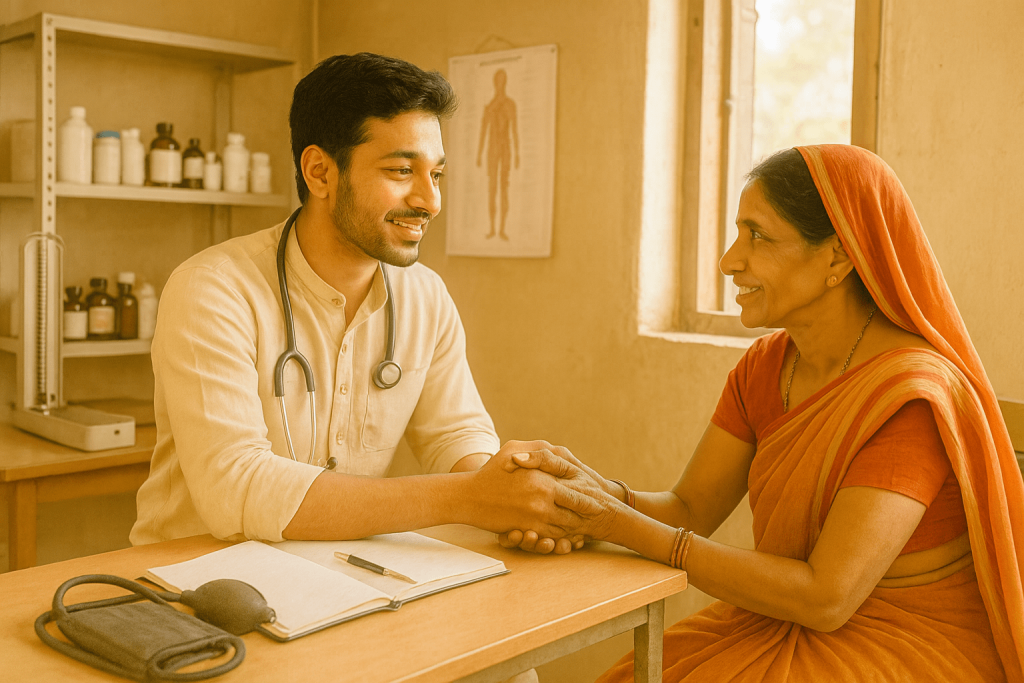
In 2020, Sandeep founded DigiSwasthya, a pioneering hybrid healthcare platform that combines telemedicine and physical clinics. The first clinic was established in his home district of Sant Kabir Nagar, Uttar Pradesh, marking the start of a transformative journey.

Building a Hybrid Healthcare Model: Combining Technology and Community Outreach

DigiSwasthya’s approach is unique. It integrates a comprehensive suite of services:

  • Telemedicine Platform: Patients can connect with qualified doctors through a secure and reliable telemedicine platform.
  • Physical Clinic: DigiSwasthya clinics provide a safe and hygienic space for patients to receive basic healthcare services and consultations.
  • Trained Nursing Staff: Experienced nursing staff ensure continuity of care and support for patients.
  • Pharmacy Partnerships: DigiSwasthya works with local pharmacies to fulfill prescriptions efficiently.

This hybrid model addresses the challenges of distance, cost, and access to qualified healthcare professionals in rural areas.

Impact and Recognition: Transforming Lives and Shaping the Future of Healthcare

DigiSwasthya’s impact has been significant, reaching numerous communities and earning recognition on both national and international stages.


Community Outreach
: DigiSwasthya has partnered with organizations like FAT, Dharma Bharti Mission, Teach for India, and Smartgaon to provide healthcare services to underserved communities across India.

Awards and Honors:The organization has been recognized for its innovative work at prestigious events like Youth Co:Lab 2022, SPAGN Dublin 2023, and The Social Hackathon.

Media Coverage: DigiSwasthya’s work has been featured in leading media channels, demonstrating its impact on the lives of rural communities.

A Vision for Sustainable Healthcare: Reaching Every Corner of India

Sandeep’s vision for DigiSwasthya extends far beyond a single clinic. He envisions a network of accessible and affordable healthcare centers across India, empowered by technology and driven by a deep commitment to serving rural communities.

Sandeep Kumar’s inclusion in the Forbes 30 Under 30 Asia list is a testament to his dedication to social impact and his innovative approach to healthcare. DigiSwasthya represents a powerful model for addressing the healthcare needs of rural communities in India, demonstrating that technology and compassion can create a healthier and more equitable future for all. Sandeep’s story serves as a powerful inspiration for aspiring social entrepreneurs and innovators, highlighting the transformative potential of grassroots innovation and technology to tackle some of the world’s most pressing challenges.

Author(s) :

ISDM

Yes

Get in touch with authors

No ratings yet

Rate this article

Yes

Key topics

Health and Wellbeing, Social Justice, Philanthropy and Human Rights

Also found in

Share

Join Our Newsletter

Explore More Articles

Paper / Report

Rethinking Impact: From Metrics to Meaning – Convening Report

How do we move beyond measuring impact as a reporting requirement to using it as a tool for learning, decision-making, and long-term change? This report captures the key discussions, insights, and emerging ideas from Rethinking Impact: From Metrics to Meaning, a convening that brought together funders, practitioners, researchers, evaluators, and development professionals to examine the future of impact measurement in India. Anchored around the launch of the Rural Development Impact Framework (RDIF) and the Development Management–Social Impact Measurement and Management (DM-SIMM) approach, the convening explored how the sector can better understand contribution, centre community perspectives, align funding with the realities of social change, and create measurement practices that support learning over compliance. The report synthesises the conversations, key takeaways, and actions that can help build a more thoughtful and effective approach to understanding impact.
Blog

Development Management: Genesis, Rationale, and the Foundations of an Emerging Discipline

Development Management (DM) arises at a junction that neither development studies nor mainstream management fully occupies on its own. Development thinking has traditionally concerned itself with what change is desirable and for whom, while management thinking has concerned itself with how collective effort gets organised and executed.
Paper / Report

A Methodological Framework for Assessing the Long-Term Impact of a Nonprofit’s Work in a Geography

This report presents the Rural Development Impact Framework (RDIF), a methodological approach for assessing the long-term impact of nonprofit organisations working within a geography. Drawing on realist evaluation, the framework shifts the focus from short-term, project-level attribution to understanding how sustained organisational engagement contributes to social change over time. Using PRADAN’s work in Gumla (Jharkhand) and Dhamtari (Chhattisgarh) as case studies, the research combines qualitative, quantitative, and geospatial methods to examine how interventions interact with local contexts to generate change. The study demonstrates that long-term impact emerges through the cumulative strengthening of livelihoods, institutions, collective agency, and governance systems, offering a practical framework for evaluating organisational contribution to rural transformation.
Paper / Report

DM-SIMM: A Funder’s Guide to Reflect, Learn, and Act on Social Impact

Across the social sector, impact measurement is often reduced to reporting numbers, meeting donor requirements, and proving results. In the process, opportunities for learning, adaptation, and meaningful decision-making are frequently lost. This guide explores how funders can rethink Social Impact Measurement and Management (SIMM) to prioritise continuous learning over compliance. Drawing on research, practitioner insights, and real-world examples, it offers practical ways to make measurement more useful, participatory, and responsive to the realities of implementation. The guide highlights the critical role of funders in shaping incentives, creating space for reflection, and enabling organisations to act on evidence. Ultimately, it presents a vision of impact practice that helps organisations learn, adapt, and stay focused on the change they seek to create.
We use essential and analytics cookies to operate this website and understand how visitors interact with it. As this site also functions as a login identity provider (IDP) for other ISDM portals, some cookies are necessary to enable secure authentication. By continuing to use this site, you consent to our use of cookies.