

Kanak AI uses machine learning on real-world training data to predict income potential and recommend targeted upskilling courses, empowering job seekers to negotiate fair wages and build stable careers.
Azad Ahmad (25), works as a Data Entry Operator in Gurgaon. He earns enough to support his family and sponsor his parent’s healthcare needs.. But it wasn’t always so. In 2021, when he graduated with a Bachelor’s degree, the COVID-19 pandemic was still raging, and he found himself navigating a tenuous job market, drifting between temporary jobs, and unsure of his earning potential. Finally, in 2024, he used Kanak AI,to predict his potential income and to get course suggestions to upskill himself. “This tool was a game changer, providing clarity on potential income and guiding me to the specific training needed to forge my future,” he says TO WHOM.
Like Ahmad, there are many job-seekers across India who lack clarity on income benchmarks, and potential career paths. Kanak AI, a data driven prediction tool that offers AI-driven salary predictions and course recommendations to professionals and job seekers, aims to solve this problem. developed as a Digital Open Solution (DOS), under the Data Science theme of the 2024 ISDM Fellowship, it enables job-seekers reliable information on fair income potential, to enable them to make an informed career decision.
The Challenge of India’s Informal Sector
India’s informal sector employs approximately 90% of the workforce and contributes nearly 45% of the GDP of the economy in the financial year 2022-23, as per National Accounts Statistics. Despite this, the overall employment rate in India remains very low–23% nationally, and 20% in urban India, underscoring the persistence of informality and limited formal job opportunities.
The situation is further complicated by the rise of digital gig platforms. These platforms frequently use opaque and unaccountable algorithms, which has been observed to worsen existing gender inequalities in the labour force [Add footnote]. This vital segment of the economy faces pervasive instability. Workers often receive low, unstable wages, with no way of knowing how to actually measure their worth and get what they deserve. This lack of standardised pay information has negative consequences for two main groups:
- Workers: Job seekers cannot determine a fair salary demand. They risk being underpaid or over-demanding and losing opportunities. This uncertainty reinforces cycles of low wages and limits career mobility.
- Employers: Informal employers lack clear guidelines to set compensation. They risk overpaying, which impacts business sustainability, or underpaying, which makes attracting and retaining skilled talent difficult.
The Kanak AI Solution
Kanak AI aims to resolve this market gap by using data to create a transparent benchmark for expected income.
The project was executed in partnership with LabourNet, a social enterprise focused on improving livelihoods. LabourNet provided the essential foundation: a vast dataset on worker training and outcomes generated from their vast programs. Kanak AI leveraged this data using a Machine Learning (ML) model, developed with the technical expertise of Datahub Technologies. The model predicts income potential based on a worker’s demographics, socio-economic factors, and verifiable skill levels.
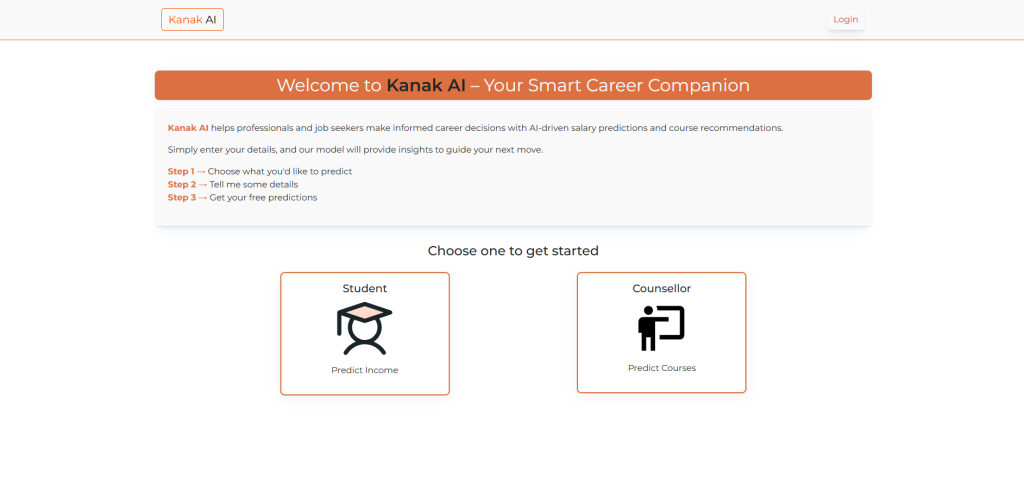
Exhibit A: landing page of Kanak AI
The final product is an open-source Digital Open Solution (DOS), ensuring the tool is transparent, accessible, and adaptable across the social sector.
Key Functional Modules
Kanak AI is delivered via a web interface featuring two primary modules:
1. Income Prediction Module
This module is designed for job seekers. Users input their personal and professional details. The ML model provides a realistic earning projection for their current or target role. This equips workers with data-backed evidence for income negotiations, fostering confidence and fairness.
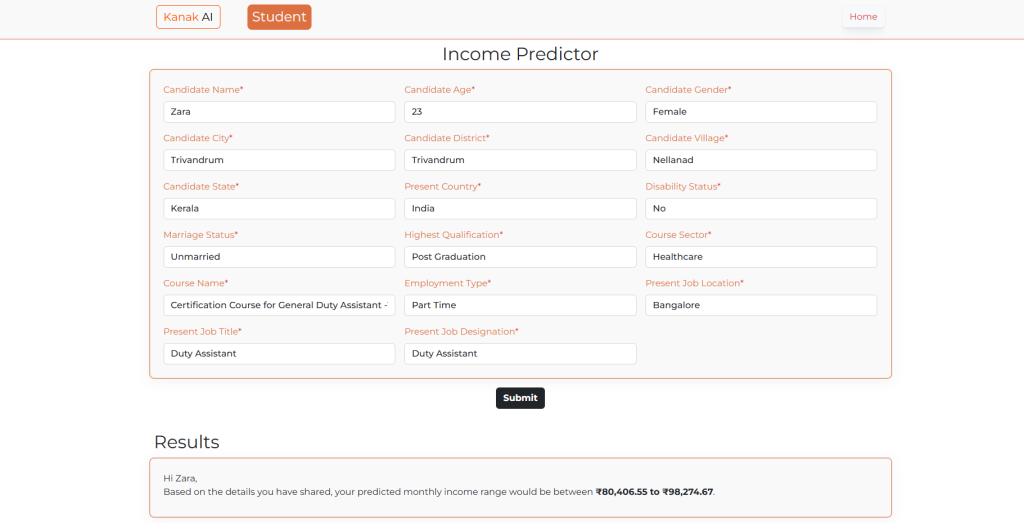
Exhibit B: Income Prediction Module of Kanak AI
2. Course Prediction Module
This module serves trainers and career advisors/counsellors. A counsellor inputs a candidate’s profile along with their expected income aspiration. The tool compares this aspiration against current market trends and data to suggest specific upskilling courses. This function transforms generic job training advice into targeted, data-driven career planning.
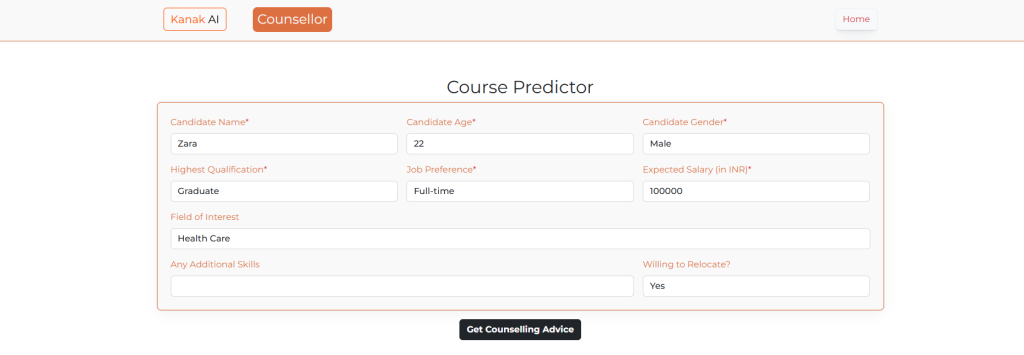
Exhibit C: Course Prediction Module Results of Kanak AI
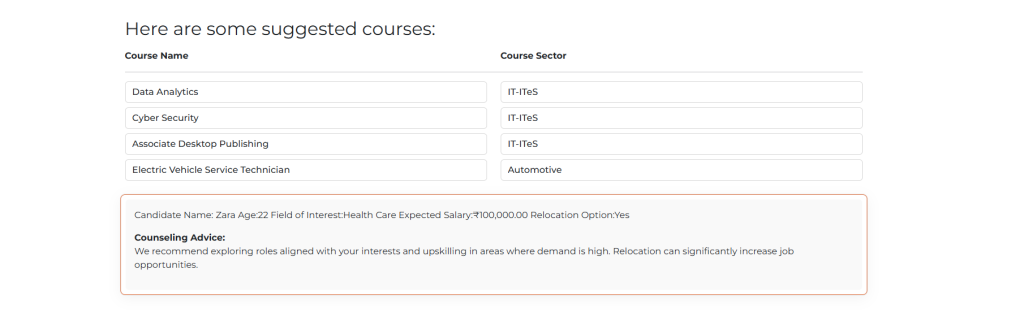
Exhibit D: Course Prediction Module Results of Kanak AI
This guidance has proved critical for professionals. Anurag Krishna, a trainer, notes that the tool helps him effectively work with marginalised youth. “I leverage the counsellor tool to cultivate genuine interest in long-term career paths… It helps me move beyond simply imparting skills to igniting a genuine desire for long-term professional growth,” he says.
Development and Impact
Kanak AI’s development followed a rigorous, iterative process, starting with multiple Proofs of Concept (PoCs). These phases focused on incrementally improving prediction accuracy by incorporating a wider range of parameters, including complex skill sets and market trends.
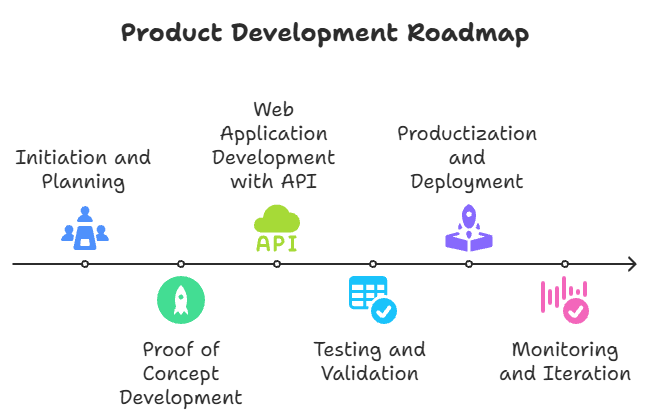
Exhibit E : Product Development Roadmap
The outcome is a reliable web application with robust backend APIs. Its release as an open-source solution ensures the models and code can be utilised and scaled by other organisations in the development sector.
Kanak AI moves beyond traditional tools that rely on generic averages. By incorporating specific worker attributes, it provides personalised insights that drive trust and equity in the labour market. The platform is designed for continuous refinement, with plans to expand its features and accommodate additional roles, demonstrating the critical role of data science in achieving economic inclusion.


