
This mobile chatbot empowers low-literacy farmers and healers by combining centuries-old ethnoveterinary knowledge with Retrieval-Augmented Generation (RAG) and voice-enabled LLMs.
The sun burned fiercely over the parched earth of Jambavanodai, a small village in Thiruvarur district in Tamil Nadu. In front of a small mud house, a group of gathered villagers were watching a sick cow lying on the ground. The cow was frothing at the mouth, and its eyes were rolling back. The worried owner had called the village veterinarian, and was waiting.
When the vet finally arrived after a few hours, he took one look at the cow and shook his head. “It’s already half-dead,” he said. “Nothing can be done.” Without touching the cow, he packed his bag and left. Moments later, Udayakumari, a 31-year-old woman, stepped forward and asked the cow’s distraught owner if she could try something. She mixed milk, water, and some herbs, and fed it to the cow, after which she left. A few hours later, her phone rang. It was the cow’s owner, awash with relief and gratitude: “It’s a miracle–the cow stood up! What is that medicine, and where did you learn about it?” Udayakumari smiled and said: “I learnt it at SEVA’s training camp.”
Udayakumari’s success demonstrates the profound potential of Ethnoveterinary Knowledge—traditional, locally sourced medicinal practices for livestock. Sadly, this centuries-old knowledge, passed down orally, is now at risk of erasure. Founded by P Vivekanandan in Madurai in 1992, SEVA (Sustainable Agriculture and Environmental Voluntary Action) is an effort to codify, systemise, validate, and disseminate this unstructured indigenous knowledge, to empower marginalised communities. In collaboration with organisations like the National Innovation Foundation, the Ministry of Animal Husbandry and Dairying, the HoneyBee Network, and SRISTI, the organisation has built a verifiable database of nearly 80,000 such traditional medicinal practices.
Using this database, Vivekanandan’s team built an AI chatbot to offer traditional herbal livestock knowledge to rural communities that needed it. This was done with the help of the 2024 ISDM Fellowship, under the data science theme.
The SEVA Vet Bot
The bot pulls knowledge from a dataset of over 150 verified traditional herbal treatment practices across multiple Indian languages, including Tamil, English, Hindi, and Kannada. Using open-source Large Language Models (LLMs) and Retrieval-Augmented Generation (RAG) techniques, the bot provides voice and text-based responses tailored to livestock health issues.
Hosted on a web-based mobile-friendly platform, the chatbot uses Google Cloud and speech processing tools to offer 24/7 access. The team has also tested the app with 500 field-level workers, gathered feedback, and refined the model for usability and accuracy.
Along the way, they had to address multiple challenges that included:
- Multilingual Data Verification: Compiling and verifying a large, multilingual database for diverse regions.
- Accessibility: Designing a user-friendly interface for low-literacy users and vast language/dialect differences.
- Trust & Accuracy: Ensuring AI response accuracy and building adoption among farmers.
- Sustainability: Optimising for the long-term sustainability of the project.
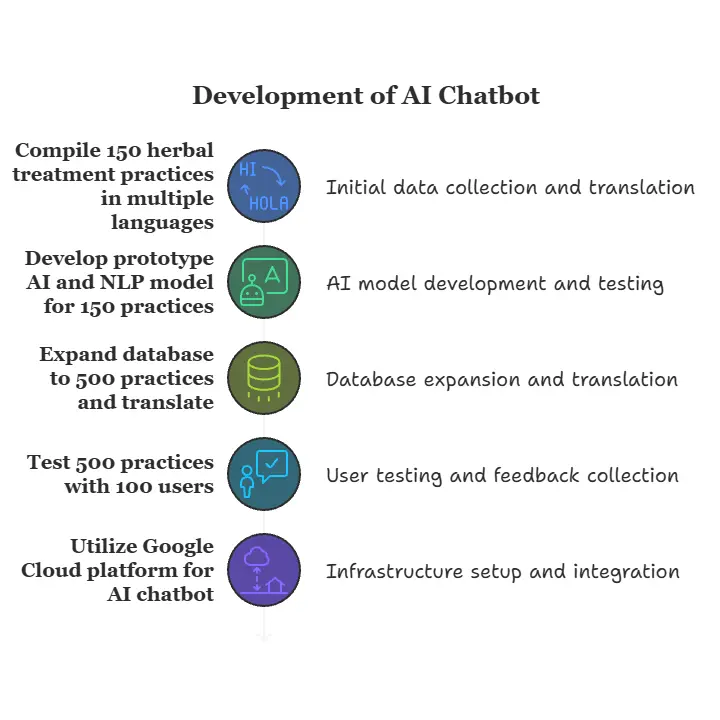
Flow chart of the activities in developing AI Chatbot
The bot has a user-friendly interface that ensures easy access for livestock keepers, even in remote areas. Built as both a mobile and web-based platform, it allows users to seek veterinary advice in their preferred mode, either through chat or voice input.
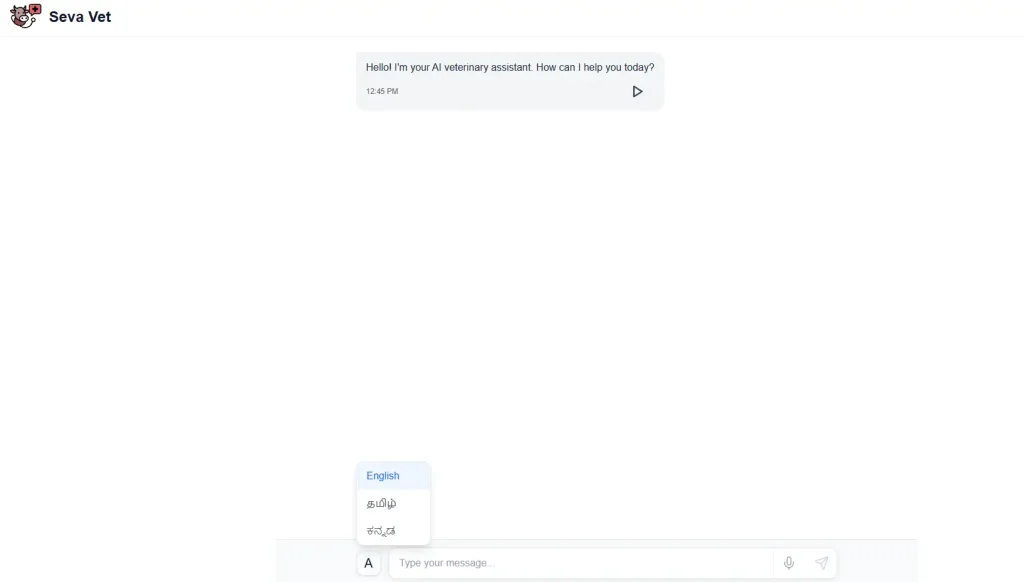
Home screen of Seva Vet Bot web page
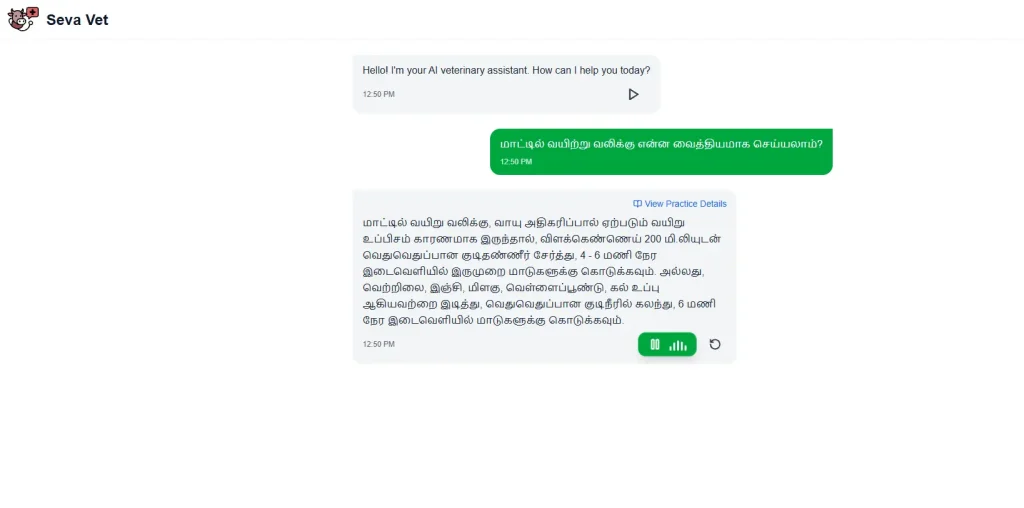
Chat Interface of SEVA Vet Bot
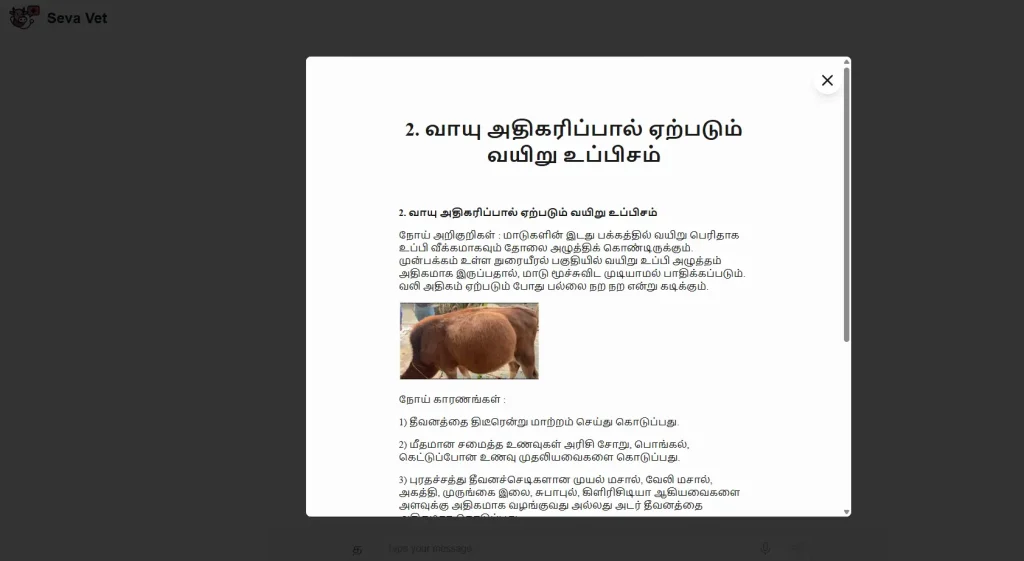
Chat Interface where the user can view the practice in detail
After the introduction of the SEVA Vet Bot, Udayakumari’s work took on a new dimension. Her practice, which was confined to the village of Jambavanodai, was no longer limited by distance or time. She began using the chatbot to diagnose and treat livestock ailments in areas she could not physically reach. In her village, she helped establish a dedicated WhatsApp group where livestock keepers could post requests for help or order herbal medicines, which Udayakumari would then deliver to their homes. The chatbot empowered her to conduct these treatments effectively and respond to twenty to thirty cases a month, drastically increasing her reach. She now uses the knowledge she gained from SEVA’s training camp into a sustainable livelihood.
Like her, Mr. Ranjith, a 32 year old self-employed ethnoveterinary practitioner in Thiruvannamalai, took the chatbot’s potential to an institutional scale. Partnering with ‘Ulavar Boomi’, a milk procurement company serving 7,000 litres per day across 38 centres, Ranjith organised health camps and treated over 500 dairy cows within three months. With the chatbot’s help, he could cross-check dosage, validate herbal combinations, and offer real-time solutions. Hundreds of such people now benefit directly or indirectly from the chatbot. Across Tamil Nadu, SEVA-trained practitioners are leveraging this tool to democratise access to animal healthcare.
Adoption and Uptake
SEVA aims to reach one million livestock-keeping communities across the country in their local languages within the next three years. To that end, the organisation has been conducting community outreach programs, training, workshops and imparting skills on using the AI chatbot. The Bot is also now augmented by voice and text interface. However, there are challenges:
- Many rural farmers are still hesitant to interact with a machine. For them, using a voice bot for animal treatment is not intuitive, and will need consistent support, peer use, and social reinforcement. They also worry about administering the correct dosage of these herbal medicines, as it depends on the weather, maturity of the cattle, and severity of the illness.
- Scaling an AI tool means spending on financial and operational costs such as server maintenance, database management, and continuous software updates.
- Translation alone does not ensure accessibility. Each linguistic region demands deep localisation, adaptation of dialects, validation of plant names and treatments, and culturally relevant field-testing. These require human facilitators, community engagement, and feedback to build trust and usability.
Over the next few years, SEVA plans to expand the Vet Bot’s database to over 500 verified herbal practices and make them accessible in 10 Indian languages. Through formal MoUs with partners such as Digital Green, Gandhi Gram Rural University, MEPCO Engineering College, NABARD, and the Ministry of Animal Husbandry, SEVA aims to build a strong ecosystem of technical, institutional, and financial support. Future development will include integration of IVR (Interactive Voice Response) and telephony so as to reach farmers without smartphones, AI refinements for dialect-based accuracy, and ongoing field testing to improve user trust and adoption.


