

This platform allows policymakers to test the cumulative impact of social security schemes, forecast household risk, and offer evidence-based policy interventions for millions of informal labourers.
On 9th September 2021, delivery and ride-share workers stood together in a protest outside the Supreme Court of India. They were demanding official recognition, which is denied to them because they are contracted as ‘partners’ rather than employees. This excludes them from essential social security benefits such as health insurance, pensions, and maternity cover. Their income is volatile, and they are not protected by a safety net unlike other jobs. The workers argued that this denial, coupled with low pay, violated their constitutional rights to equality (Article 14), right to work and livelihood (Article 21), and right to decent and fair conditions of work (Article 23).
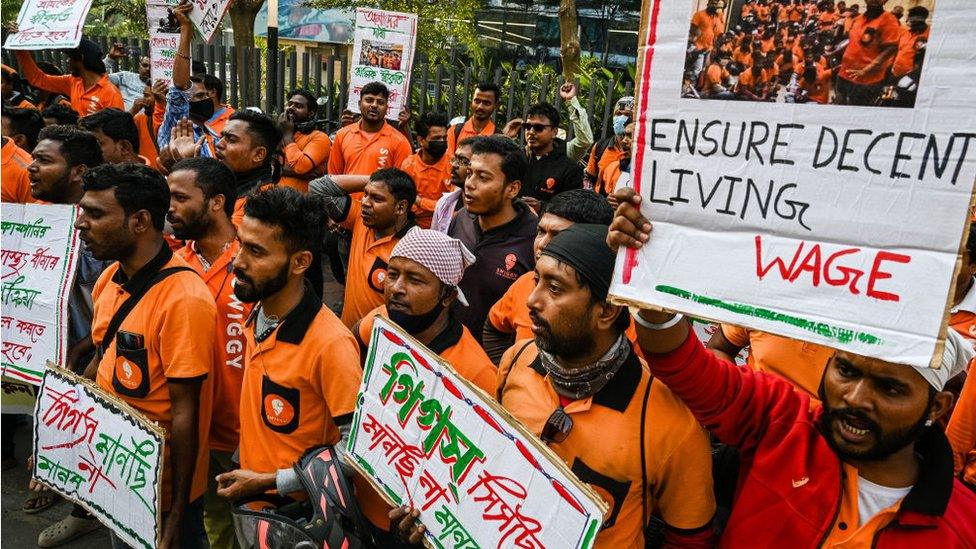
This struggle represents the immense challenge facing millions of India’s such vulnerable workers. Policy has struggled to keep pace with the rise in gig work, and it often lacks the tools to accurately identify, measure, and protect households before a crisis hits. The EQLT (Equity & Livelihood Toolkit) was developed to solve this exact problem. A Social Security Simulation Platform, it was developed under the aegis of the data science theme of the ISDM Fellowship 2024, to translate complex social data into actionable policy insights. The project was executed in partnership with Fields of View, a not-for-profit group specialising in using games and simulations to inform policy.
The many dimensions of vulnerability
Vulnerability is a complex problem influenced by factors that traditional policy filters often fail to capture. A household can appear stable, but just one crisis—a job loss, an injury, a climate event—can render it precarious.
EQLT was designed to address this complexity, recognising that vulnerability stems from a multi-dimensional interplay of factors:
- Structural and Institutional Factors: Gaps in finance, markets, effective governance, and systemic inequities (caste, gender).
- Infrastructure Deficits: Poor housing, inadequate public services, and limited access to resources.
- Capability Gaps: Deficits in household financial stability, education, health, and awareness.
- External Shocks: Climate change, natural disasters, policy changes, and personal crises.
Historically, policymakers and civil society organisations (CSOs) have lacked tools to effectively coordinate efforts against this complexity. They need to find ways to move from reactive aid to proactive protection by:
- Defining and Detecting: Accurately capturing vulnerability that stems from informal work, care burdens, or structural discrimination.
- Testing Efficacy: Determining the true cumulative impact of various social security interventions working together.
- Forecasting Risk: Predicting vulnerability before it deepens, allowing for targeted, timely interventions.
EQLT:The Social Protection Score
EQLT2 was designed to resolve this gap by creating a virtual policy laboratory where stakeholders can model communities, simulate economic and environmental shocks, and precisely plan for resilience.
EQLT is a data-driven tool that uses a system dynamics modelling approach built on the Sustainable Livelihood Approach framework(SLA)(Serrat,2017) which considers the five kinds of capital and integrates the impact of shocks, household vulnerability, resilience mechanism and the trade off inherent to the household well-being. This model integrates physical, financial, and human capital to examine how households allocate resources, cope with income shortfalls, and respond to crises.
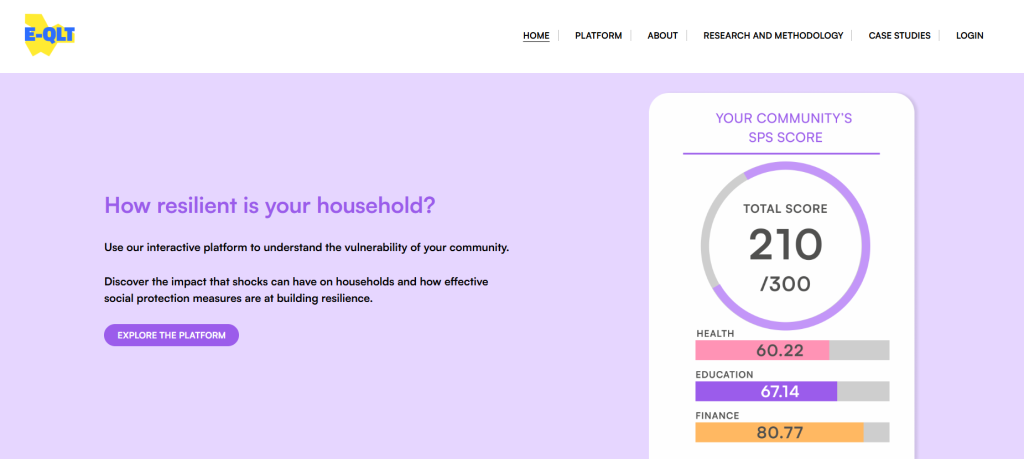
User Interface of the Platform: Landing page
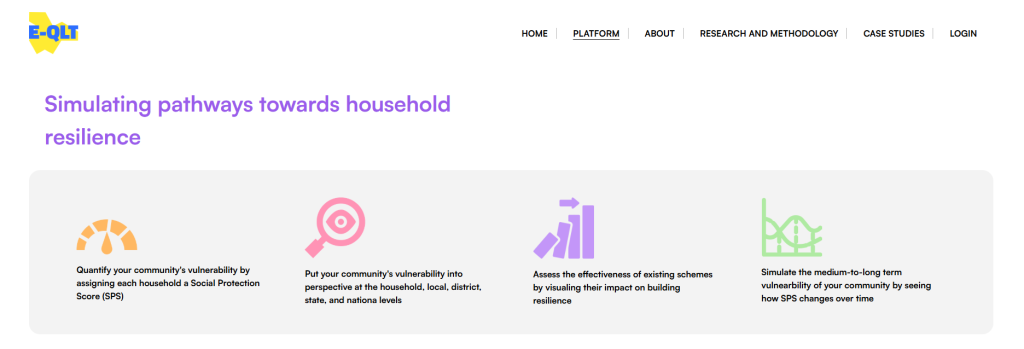
User Interface: Platform details
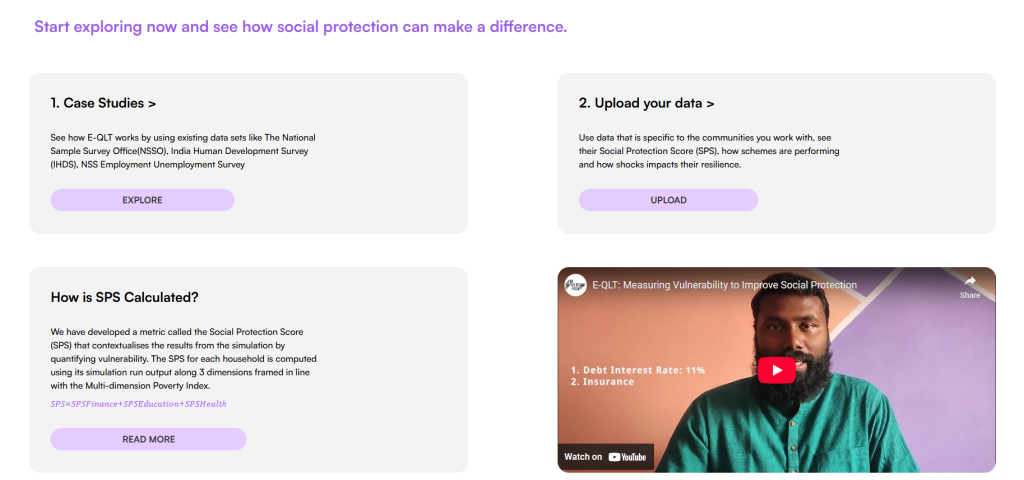
User Interface: Platform details
The platform uses vast foundational datasets, including:
- Socio-economic data from the Indian Human Development Survey (IHDS-II) and NSSO Employment-Unemployment surveys.
- Comprehensive data on over 180 social protection schemes (categorised into debt-based, insurance, cash transfers, etc.).
- Historical disaster data from sources including Desinventor and EM-DAT.
Assessing Household Vulnerability via SPS
EQLT quantifies the vulnerability of a household using the Social Protection Score (SPS), a simple, comparative indicator that functions similarly to a credit score. The SPS is calculated using the model’s output across three key dimensions of multi-dimensional poverty:
- Finance: Measured by the time taken to repay debt.
- Health: Measured by nutritional deficits and Disability-Adjusted Life Years (DALYs).
- Education: Measured by age-specific years of schooling.
The SPS is a score between 0 and 300; a score below 300 indicates vulnerability, and 0 refers to critical vulnerability. By sub-dividing the score, the platform allows users to instantly understand where the vulnerability stems from (e.g., primarily financial debt or health deficits).
Evaluating Intervention Efficacy
EQLT allows stakeholders to test interventions in real-time. Users can add existing or potential social security schemes to a household’s profile and instantly see the calculated increase in the SPS. This function is vital for:
- Testing Compound Effect: Seeing how different schemes act together to build cumulative resilience.
- Quantifying Policy: Translating scheme access into a measurable increase in a household’s stability.
The platform includes a temporal view feature that allows users to track exactly how a household’s vulnerability score changes over time following a simulated shock or a newly applied intervention.
Development and Application
The development process began with a rigorous User Needs Assessment to ensure the platform addressed real-world priorities. This included a scoping workshop and a review of 35 advocacy outputs, which collectively highlighted three core use cases for the platform:
- Demonstrating Gains: Using evidence to show the potential benefits from improved implementation of existing social protection measures.
- Testing Eligibility: Simulating the impact of changes to the eligibility criteria of current schemes.
- Designing Schemes (Future): Laying the groundwork for testing the effects of completely redesigned social security policies.
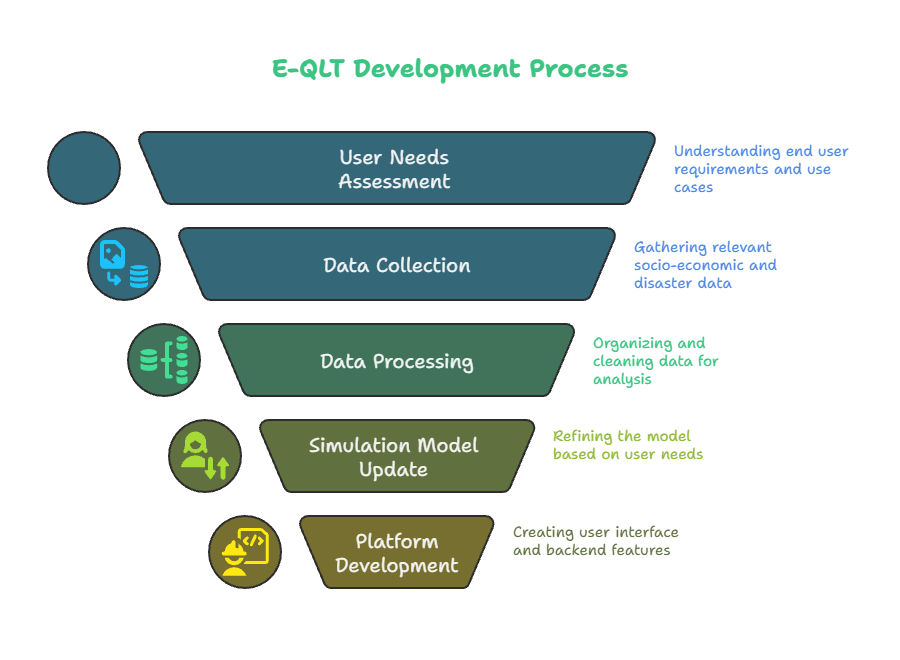
The EQLT platform is designed as an accessible open-access tool. Users can explore public datasets or upload their own community data for customised use. The technical infrastructure is robust, built with a frontend using HTML, CSS, and Vue.js and a backend running on Flask (Python) with MySQL for storage.
Acknowledging Complexity
While EQLT provides a powerful, quantifiable metric, it acknowledges that vulnerability remains far more complex than a simulation can fully capture. The platform currently focuses on measurable domains such as finance, education, and health. It does not model some other crucial factors such as mental health, structural discrimination (deep-rooted exclusion based on caste, gender, and disability), and awareness and access (the inability of people to access entitlements due to lack of information or complex bureaucratic processes).
Despite these exclusions, EQLT is an essential companion to modern policymaking. It allows governments and institutions to design more responsive, data-informed, and equitable interventions for households and vulnerable populations


