

State of the Sector: A Report on the Data Maturity of Social Purpose Organisations in India
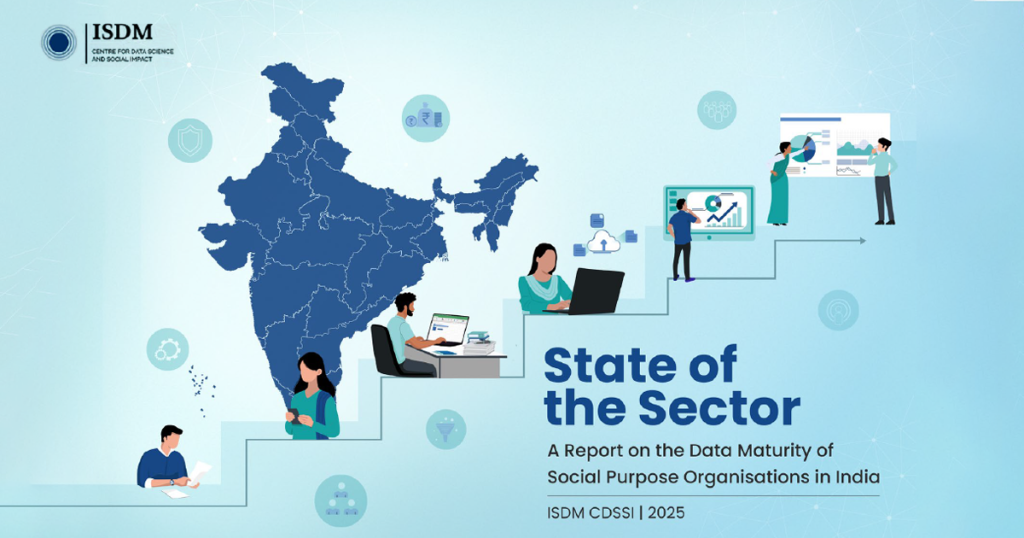
The State of the Sector Report offers insights into data readiness and barriers within the social sector across various relevant segments such as type of organisation, thematic areas of work, organisational size, annual expenditure, and geographic presence. The report is designed to shed light on specific challenges faced by organisations in their data maturity, journey and to inspire funders and ecosystem enablers to invest resources in advancing data maturity within the sector.

Author(s) :

ISDM CDSSI

Contact Author : cdssi@isdm.org.in

Get in touch with authors

3.8
4 ratings

Rate this article

Key topics

Data Science for social impact

Also found in

Share

Join Our Newsletter

Explore More Articles

Blog

Development Management: Genesis, Rationale, and the Foundations of an Emerging Discipline

Development Management (DM) arises at a junction that neither development studies nor mainstream management fully occupies on its own. Development thinking has traditionally concerned itself with what change is desirable and for whom, while management thinking has concerned itself with how collective effort gets organised and executed.
Paper / Report

A Methodological Framework for Assessing the Long-Term Impact of a Nonprofit’s Work in a Geography

This report presents the Rural Development Impact Framework (RDIF), a methodological approach for assessing the long-term impact of nonprofit organisations working within a geography. Drawing on realist evaluation, the framework shifts the focus from short-term, project-level attribution to understanding how sustained organisational engagement contributes to social change over time. Using PRADAN’s work in Gumla (Jharkhand) and Dhamtari (Chhattisgarh) as case studies, the research combines qualitative, quantitative, and geospatial methods to examine how interventions interact with local contexts to generate change. The study demonstrates that long-term impact emerges through the cumulative strengthening of livelihoods, institutions, collective agency, and governance systems, offering a practical framework for evaluating organisational contribution to rural transformation.
Paper / Report

DM-SIMM: A Funder’s Guide to Reflect, Learn, and Act on Social Impact

Across the social sector, impact measurement is often reduced to reporting numbers, meeting donor requirements, and proving results. In the process, opportunities for learning, adaptation, and meaningful decision-making are frequently lost. This guide explores how funders can rethink Social Impact Measurement and Management (SIMM) to prioritise continuous learning over compliance. Drawing on research, practitioner insights, and real-world examples, it offers practical ways to make measurement more useful, participatory, and responsive to the realities of implementation. The guide highlights the critical role of funders in shaping incentives, creating space for reflection, and enabling organisations to act on evidence. Ultimately, it presents a vision of impact practice that helps organisations learn, adapt, and stay focused on the change they seek to create.
Paper / Report

Reimagining Social Impact Measurement and Management (SIMM) Practices

This paper argues that the challenges in Social Impact Measurement and Management (SIMM) are not primarily technical, but rooted in power dynamics, institutional incentives, and prevailing notions of accountability. An analysis of the SIMM ecosystem identifies three core problems: persistent power asymmetries, an overemphasis on proving impact rather than strengthening pathways to it, and the treatment of measurement as a compliance exercise rather than a learning practice. In response, the paper proposes three interconnected principles: redistributing power in measurement governance, designing for learning-oriented impact pathways, and institutionalising prospective, community-centred measurement to enable more meaningful, adaptive, and sustainable social impact.
We use essential and analytics cookies to operate this website and understand how visitors interact with it. As this site also functions as a login identity provider (IDP) for other ISDM portals, some cookies are necessary to enable secure authentication. By continuing to use this site, you consent to our use of cookies.