

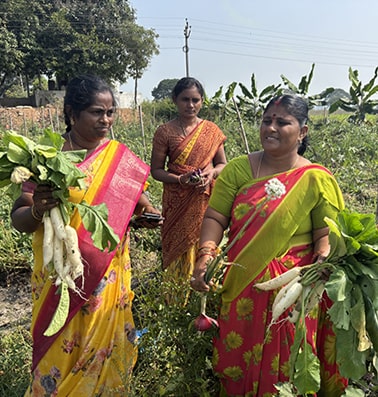
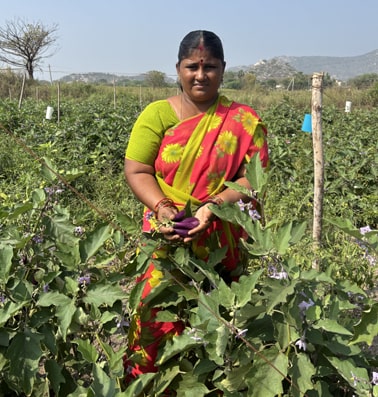
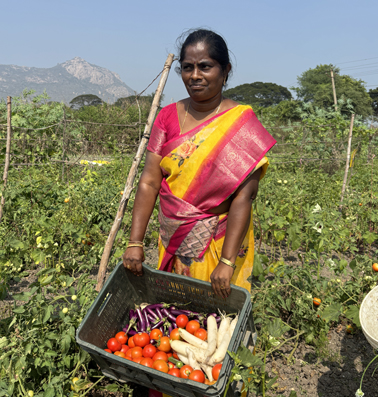
Kothapalli Jyothi (32) has hitched up her bright green-and-pink saree, and is plucking onions, brinjals, tomatoes and radishes as she walks nimbly through rows of vegetable crops. Behind her is a sea of fiery red chillies, glistening sharply in the afternoon sun. This healthy produce, and bountiful harvest in her five-acre farm (on lease) in Bellamkonda in Palnadu district of Andhra Pradesh is the product of good farming practices, many of which she has been learning about on her own through the FarmerChat application developed by Digital Green.
FarmerChat, developed and deployed in 2023, is an AI-driven chatbot (that can be queried in natural language) and Android application that helps farmers and agricultural extension workers in the remotest regions of the country get reliable, customised information and advisories to help increase their agricultural productivity.
It’s been trained on a variety of data points – from government data from ministries, to agricultural practices from research institutions and universities, private sector partnership data such as market and weather information, and Digital Green’s own repository of peer-to-peer and other video advisories. The result? Information on demand, cutting down the farmers’ need to travel to Farmer Producer Organisations (FPOs) and meeting with extension workers every time they want answers on best prices, pesticide treatments, and the like.
Information at their fingertips
Access to information was always a basic need for farmers – whether it was on soil health, organic techniques, or pesticide management, believes Gautam Mandewalker, Senior Director, Product Management, Digital Green. He explains: “Farmers who were more digitally literate would check YouTube or Google. Others would read the newspaper, ask their peers, the horticulture department, or extension workers.”
Digital Green had offered different iterations of information dissemination in the past, too. Many, such as videos, IVR-based systems, SMS-based systems, and deterministic chatbots through WhatsApp, received a good response from farmers during the cropping season. A Telegram chatbot launched in October 2023 was used by approximately 12,000 users across 3 countries (Ethiopia, Kenya and India) and 10 states in India (Andhra Pradesh, Telangana, Odisha, Gujarat, Rajasthan, Uttar Pradesh, Bihar, Madhya Pradesh, Assam, and Karnataka). “But it was very expensive to scale these systems, and it didn’t allow us to build innovative features and drive engagement in ways that farmers were demanding,” says Mandewalker.
The solution presented itself with the advent of conversational AI, which is powering the iteration of FarmerChat we see today. Built for low-literacy and low-connectivity users, it supports voice, text, and photo queries, and is designed to respond to seasonal, gender-specific, and climate-sensitive needs. “Now through FarmerChat, farmers and extension workers can simply search for that information in a chat interface, like they do on WhatsApp and Telegram,” Mandewalker says.
Powered by technology
SaiPrasad Chirivirala, Head of Products at Digital Green, explains that FarmerChat uses Retrieval Augmented Generation (RAG) to pull answers from knowledge repositories. These repositories include government advisories and content from departments such as Horticulture, Krishi Vigyan Kendras, and others, as well as international journals.
“With FarmerChat, we have complemented our RAG system with direct inference. This allows farmers to access information that is also outside the scope of these content repositories – say, from other broad-based sources of agricultural information. For example, if a farmer has used a particular type of pesticide and wants another recommendation, FarmerChat can still provide those recommendations even if the answer isn’t contained in the curated content,” he says.
Chirivirala says they have seen a correlation between farmers with high acreage and the volume or queries they ask on the app. Small and marginal farmers are less likely to own smartphones, and therefore ask their questions to frontline extension workers, while farmers with farms bigger than 5–10 hectares tend to have smartphones, and therefore ask more questions.
Farmers also had queries beyond agricultural practices – they asked about subsidies, schemes, loans, etc. Because FarmerChat uses LLMs, it can offer nudges and notifications that supply this information or prompt the farmer to engage more with the app. “For every question, the app generates 3 follow-ups, prompting more questions,” Chirivirala explains.
For the farmers
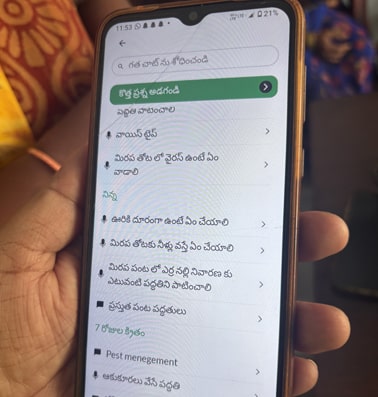
The app is available in 20+ languages. The Indian languages include Hindi, Kannada, Marathi, Odia and Telugu. Internationally, it is available in Swahili, Amharic, Oromo, French, Hausa, Kinyarwanda, Portuguese, Spanish, Shona and Zulu. Still, the number of queries asked via voice is five times that of text. There are more usage statistics, which tell their own story:
- Queries mostly relate to pest & disease management (30%), seeds (15%), and fertilisers (10%).
- Bihar, Odisha, Jharkhand, Karnataka, UP, AP, Telangana and MP top the list of states asking questions.
- Over 50% of the queries come from male farmers, which could be because many women farmers do not own smartphones.
Expanding their reach
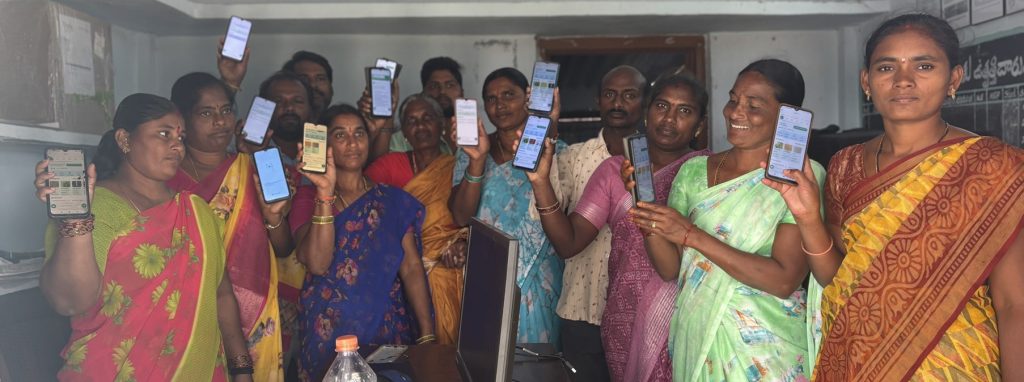
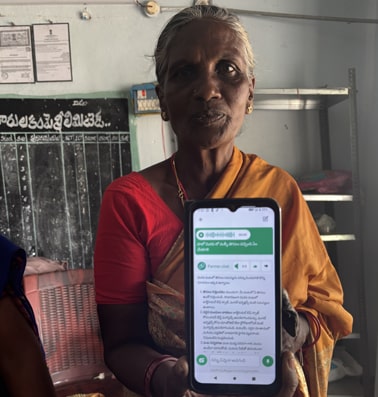
Vemula Padmavathi (55), is not one of them. She tells us that when she wanted to know how to tackle the leaf borers infesting her one-acre paddy field, she took a photo and uploaded it to the app. “I got suggestions to install sticky traps and pheromone traps to catch the borers, and install bird perches to attract birds that will eat the borers,” she says with a smile, showing us the app on her phone at the FPO office in Bellamkonda.
Like her, over 2,25,000 others now use FarmerChat across India, Ethiopia, Kenya and Nigeria. Of these, India accounts for over 1,60,000 users. Questions range from the best sowing techniques, to remedies for pests, information on schemes and subsidies, and best markets to buy and sell. Akula Sarswati (38), for example, says she got detailed advice about intercropping on her two-acre farm from FarmerChat. Based on that information, today, she plants coriander and onion in between her chilli plants, to manage pests.
Similarly, Jyothi, who was using marigold as an intercrop, now also plants beetroot, radish, coriander, and onion every six rows, “to control black thrips, and allow the chilli to extract nutrients from the soil”. She got this information from FarmerChat. It’s a double bonus — her income has increased as a result of the bounty from the chilli as well as the additional intercrops.
Over time, more features have been added, based on farmer inputs. The weather widget, for instance, is a big hit. “Farmers wanted to see the weather at a glance. They didn’t want to have to ask the app every day. So we created a widget that shows a seven-day forecast. And if they tap a button, they get a three-day forecast in natural language,” says Mandewalker. Text-to-speech was also introduced after they realised that farmers did not want to type and ask questions. Follow-up questions were introduced to make the app more proactive to use. The option to listen to the answers instead of reading them, was also a much-requested feature.
Coming up
Next on the anvil is enhanced video support, and support for more Indian languages. Digital Green also wants to test leaderboards and offer a gamification model where farmers who refer the app to others get incentives. Offline access and AI generated personalised crop calendars are also in the works.
The plan is also to make FarmerChat a unified, actionable solution that also addresses other requirements in the farmer’s journey, for eg: purchasing implements and livestock, seeking information on investing, or registering for government schemes. Mandewalker explains, “So instead of them just seeking information by asking a question,they can directly access that information because somebody else will be able to reach out to them through the app — say a scientist, or a service provider who is into drone services or seed supply, and so on”.
Jyothi, who has been growing paddy, vegetables, and chillies for the last 10 years, loves using the speech-to-voice feature on FarmerChat. “I had a lot of problems with pests. So I would take a photo on my phone, go to the frontline extension worker at the office, and show it to them. Or I would pluck a sapling, take it to the shop, and ask for remedies. With FarmerChat, getting advice has become much simpler. It saves me both time and money,” she says, before briskly making her through her field with a bunch of blood red chillies in her hand.
Want us to tell your data story? Write to us at cdssi@isdm.org.in with “Data Stories” in the subject line.


