

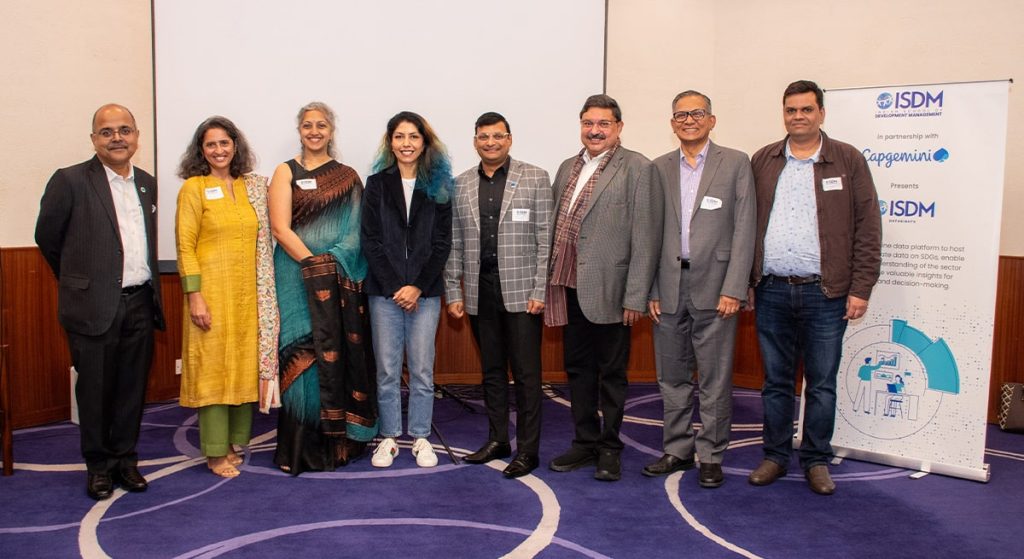
All For Data, Data For All

ISDM, in collaboration with Capgemini, launched ISDM DataSights, a user-friendly, free-to-use data portal that can help grassroots organisations work towards the Sustainable Development Goals (SDGs)Big Data is transforming some of the world’s biggest businesses, so why should the social sector be left behind?When Social Purpose Organisations (SPOs) have easy access to high-quality, reliable, contextualised data, they can make better program decisions, streamline organisational thinking, and scale up their impact. But the data available in the public sphere is often fragmented,…

ISDM, in collaboration with Capgemini, launched ISDM DataSights, a user-friendly, free-to-use data portal that can help grassroots organisations work towards the Sustainable Development Goals (SDGs)

Big Data is transforming some of the world’s biggest businesses, so why should the social sector be left behind?

When Social Purpose Organisations (SPOs) have easy access to high-quality, reliable, contextualised data, they can make better program decisions, streamline organisational thinking, and scale up their impact. But the data available in the public sphere is often fragmented, unreliable, and hard to access and analyse, which means grassroots SPOs in particular, are left out of the data revolution.
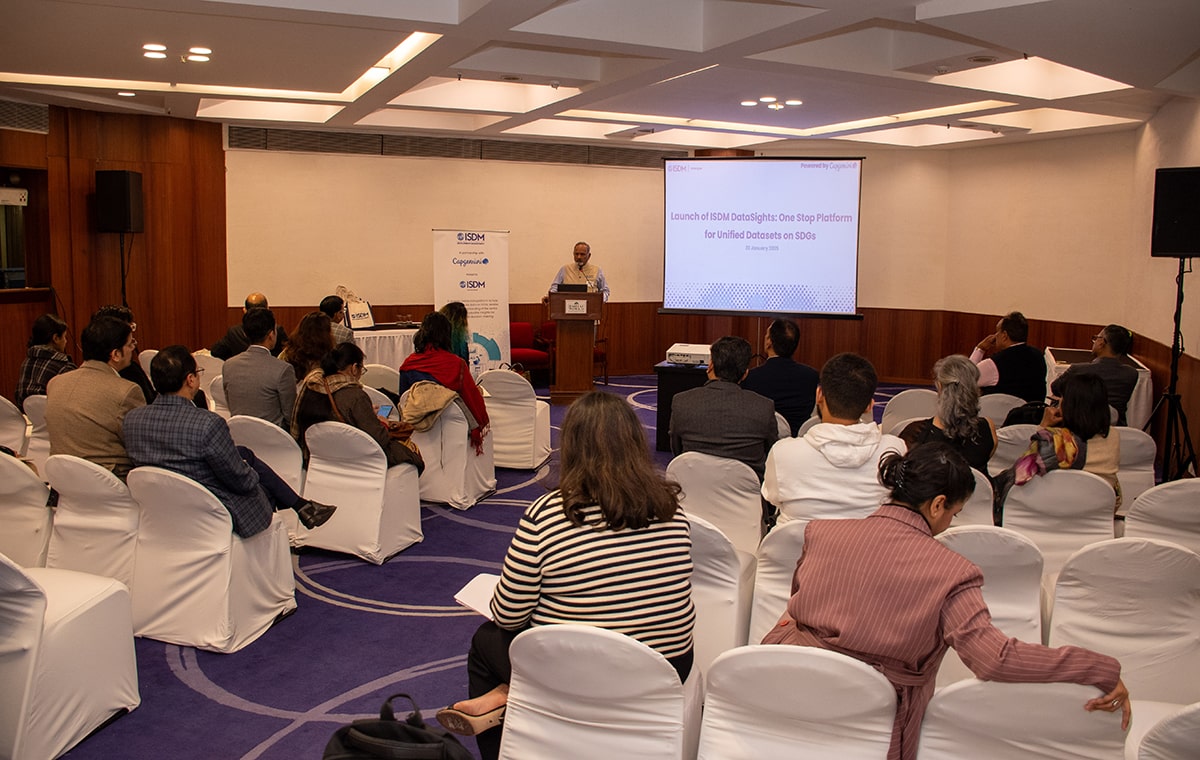
To address this gap, ISDM DataSights, powered by Capgemini, was launched on 23rd January 2025 at the India Habitat Centre in New Delhi. At the launch, 43 participants from the development sector and academia saw firsthand how this platform makes reliable, actionable data easily accessible to SPOs.

Data, democratised

While the corporate sector uses data to drive efficiency and growth, the social sector is unable to do the same at scale. Ravi Sreedharan, President and Co-founder of ISDM, talked about this challenge in his opening plenary: “Only 20 organisations in the social sector have an annual budget of more than ₹100 crore. The sector operates at a mini scale, yet it deals with some of the biggest challenges of our time. If we are serious about creating impact at scale, data must be at the centre of decision-making.”
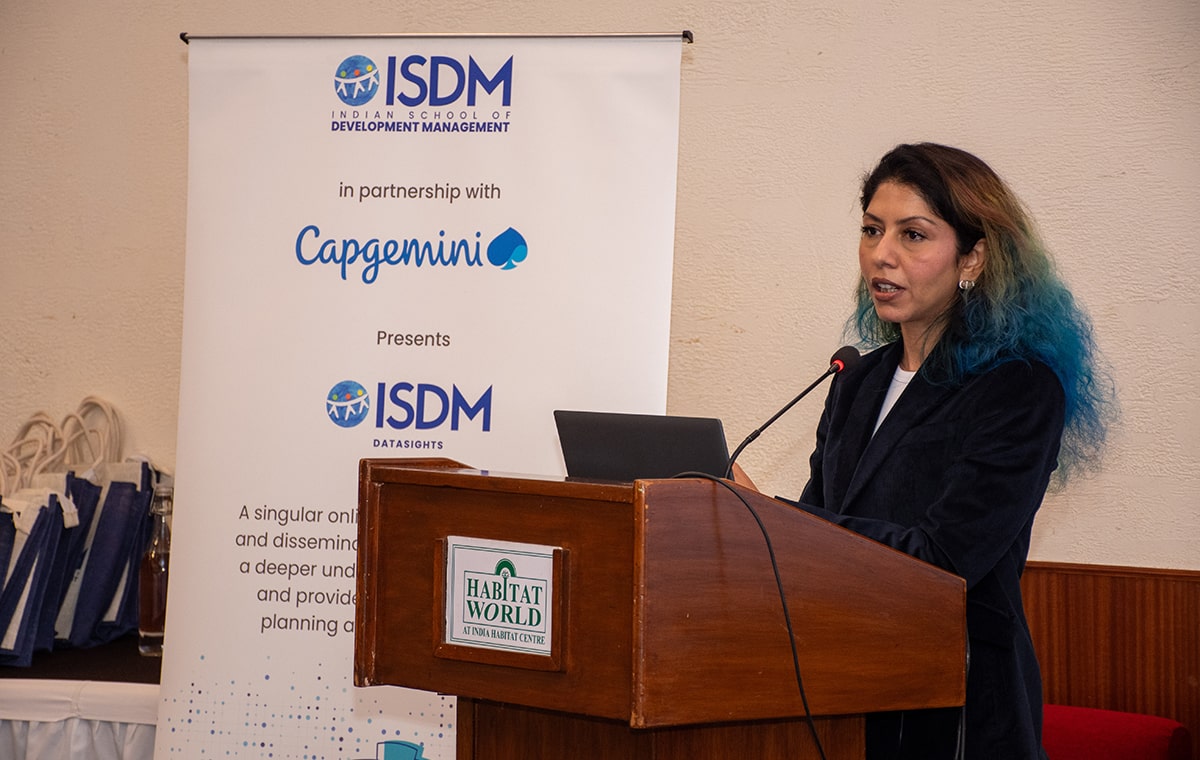
That’s where platforms such as ISDM DataSights come in. It is a free-to-use, single-window data platform that hosts unified data on the SDGs. It consolidates diverse datasets, and offers advanced analysis tools and visualisation capabilities to help address the social sector’s critical data challenge.

Aarti Srivastava, Chief Human Resources Officer – India, Capgemini, spoke on Capgemini’s vision for ISDM DataSights at the launch: “At Capgemini, we are dedicated to leveraging technology to drive meaningful, positive change, aligning our innovations with the goal of societal impact. ISDM DataSights reflects Capgemini’s mission to turn technological expertise into tools for social transformation.”

No more gatekeeping

The social sector needs more high-quality data to make informed decisions, track progress, measure success, and allocate resources effectively to drive impact. Because many SPOs operate on limited budgets, the sector needs more open-source data platforms like DataSights to enhance their data capabilities.
The launch chief guest, Dr. Rajesh Shukla, MD and CEO of People’s Research on India’s Consumer Economy (PRICE), emphasised the importance of data democratisation for the social sector. “Data is the new dollar. Without updated, high-quality data, interventions are blind guesses. The government alone cannot do everything – we need platforms like ISDM DataSights to bridge the gap.”

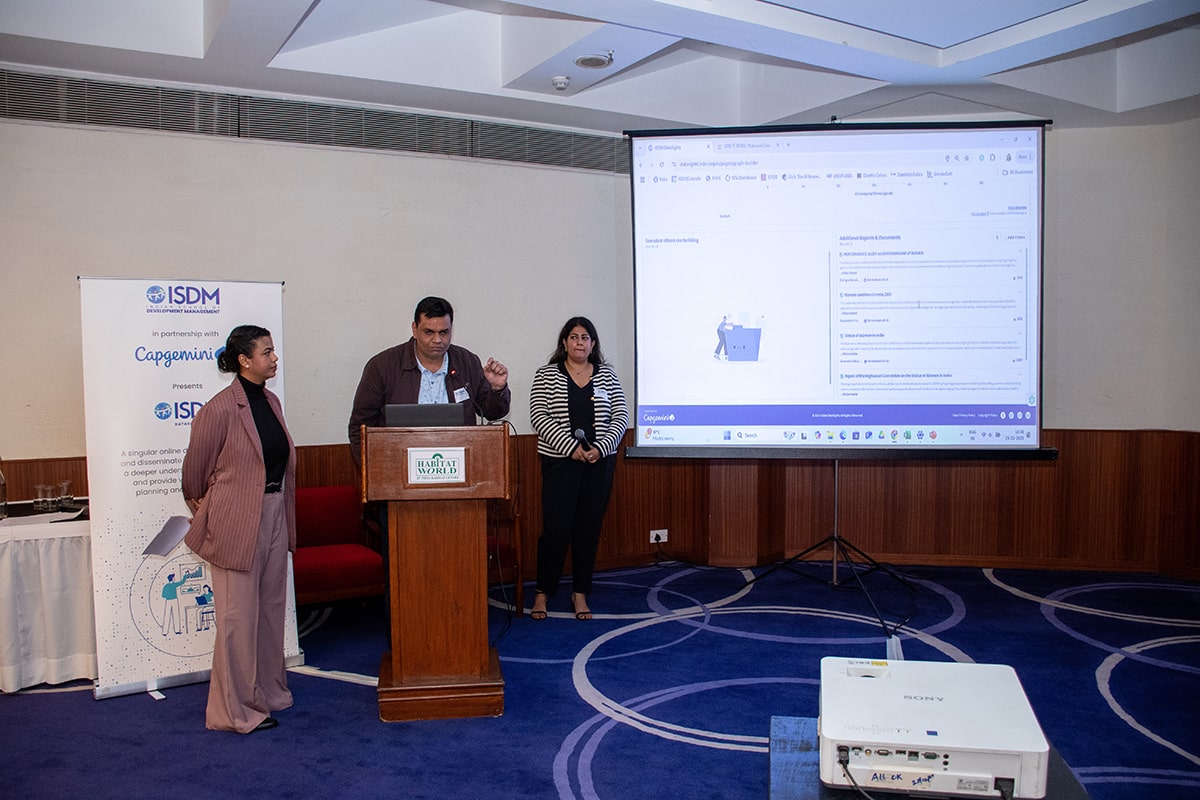
At the launch, a demonstration of ISDM DataSights’ capabilities showed how beta users have already used the platform to enhance their work.

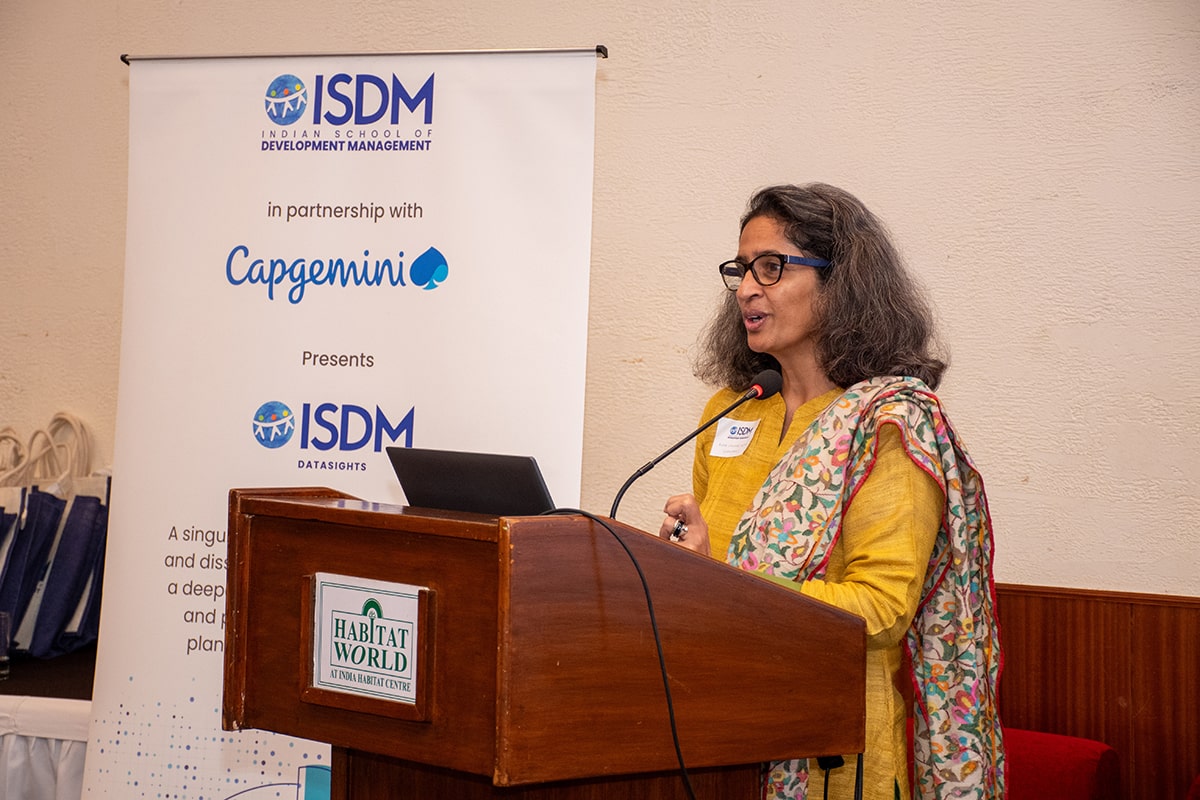
Following this, Roma Nawani Sachdev, EVP and Chief Marketing & Communications Officer – India, Capgemini, said, “We are only stopping the democratisation of data by not using it and by not becoming data-centric.” She also urged SPOs to consider if they are using data to its full potential and in sectors where it matters most.

Tech for good

The event concluded with a panel discussion on ‘The Relevance of Technology and Data for the Social Sector’, moderated by Dr Anand Rao, a Distinguished Service Professor of Applied Data Science and AI at Carnegie Mellon University.
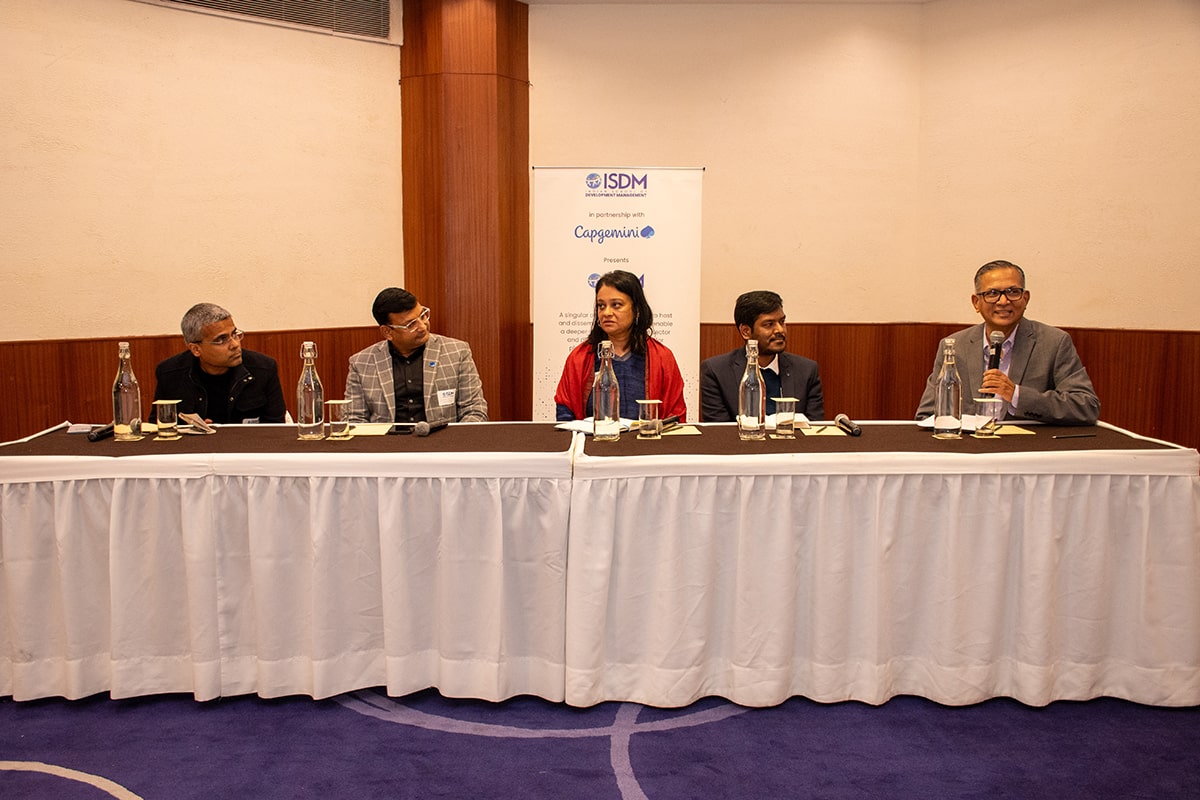
The panel featured:

  • Anupam Jain – Head of Engineering, Give

  • Saurabh Srivastava – Director, Insights & Data, Capgemini

  • Shahana Chattaraj – Director of Research, WRI Center for Governance and Equity at the World Resources Institute (WRI)

  • Sourav Das – Training Manager, J-PAL South Asia

    The discussion focused on how ISDM DataSights lets SPOs integrate diverse datasets and draw insights. The key takeaway was that collaboration and data donation are essential for scaling the platform’s impact.

Towards a data-driven future

Limited access to high-quality data has held the social sector back from maximising its impact. But with platforms like ISDM DataSights, the sector is a step closer to strengthening decision-making through actionable insights, tracking progress, and optimising interventions.
Author(s) :

ISDM

Contact Author : datasights@isdm.org.in
Yes

Get in touch with authors

No ratings yet

Rate this article

Yes

Key topics

Data Science for social impact

Also found in

Share

Join Our Newsletter

Explore More Articles

Paper / Report

Rethinking Impact: From Metrics to Meaning – Convening Report

How do we move beyond measuring impact as a reporting requirement to using it as a tool for learning, decision-making, and long-term change? This report captures the key discussions, insights, and emerging ideas from Rethinking Impact: From Metrics to Meaning, a convening that brought together funders, practitioners, researchers, evaluators, and development professionals to examine the future of impact measurement in India. Anchored around the launch of the Rural Development Impact Framework (RDIF) and the Development Management–Social Impact Measurement and Management (DM-SIMM) approach, the convening explored how the sector can better understand contribution, centre community perspectives, align funding with the realities of social change, and create measurement practices that support learning over compliance. The report synthesises the conversations, key takeaways, and actions that can help build a more thoughtful and effective approach to understanding impact.
Blog

Development Management: Genesis, Rationale, and the Foundations of an Emerging Discipline

Development Management (DM) arises at a junction that neither development studies nor mainstream management fully occupies on its own. Development thinking has traditionally concerned itself with what change is desirable and for whom, while management thinking has concerned itself with how collective effort gets organised and executed.
Paper / Report

A Methodological Framework for Assessing the Long-Term Impact of a Nonprofit’s Work in a Geography

This report presents the Rural Development Impact Framework (RDIF), a methodological approach for assessing the long-term impact of nonprofit organisations working within a geography. Drawing on realist evaluation, the framework shifts the focus from short-term, project-level attribution to understanding how sustained organisational engagement contributes to social change over time. Using PRADAN’s work in Gumla (Jharkhand) and Dhamtari (Chhattisgarh) as case studies, the research combines qualitative, quantitative, and geospatial methods to examine how interventions interact with local contexts to generate change. The study demonstrates that long-term impact emerges through the cumulative strengthening of livelihoods, institutions, collective agency, and governance systems, offering a practical framework for evaluating organisational contribution to rural transformation.
Paper / Report

DM-SIMM: A Funder’s Guide to Reflect, Learn, and Act on Social Impact

Across the social sector, impact measurement is often reduced to reporting numbers, meeting donor requirements, and proving results. In the process, opportunities for learning, adaptation, and meaningful decision-making are frequently lost. This guide explores how funders can rethink Social Impact Measurement and Management (SIMM) to prioritise continuous learning over compliance. Drawing on research, practitioner insights, and real-world examples, it offers practical ways to make measurement more useful, participatory, and responsive to the realities of implementation. The guide highlights the critical role of funders in shaping incentives, creating space for reflection, and enabling organisations to act on evidence. Ultimately, it presents a vision of impact practice that helps organisations learn, adapt, and stay focused on the change they seek to create.
We use essential and analytics cookies to operate this website and understand how visitors interact with it. As this site also functions as a login identity provider (IDP) for other ISDM portals, some cookies are necessary to enable secure authentication. By continuing to use this site, you consent to our use of cookies.