

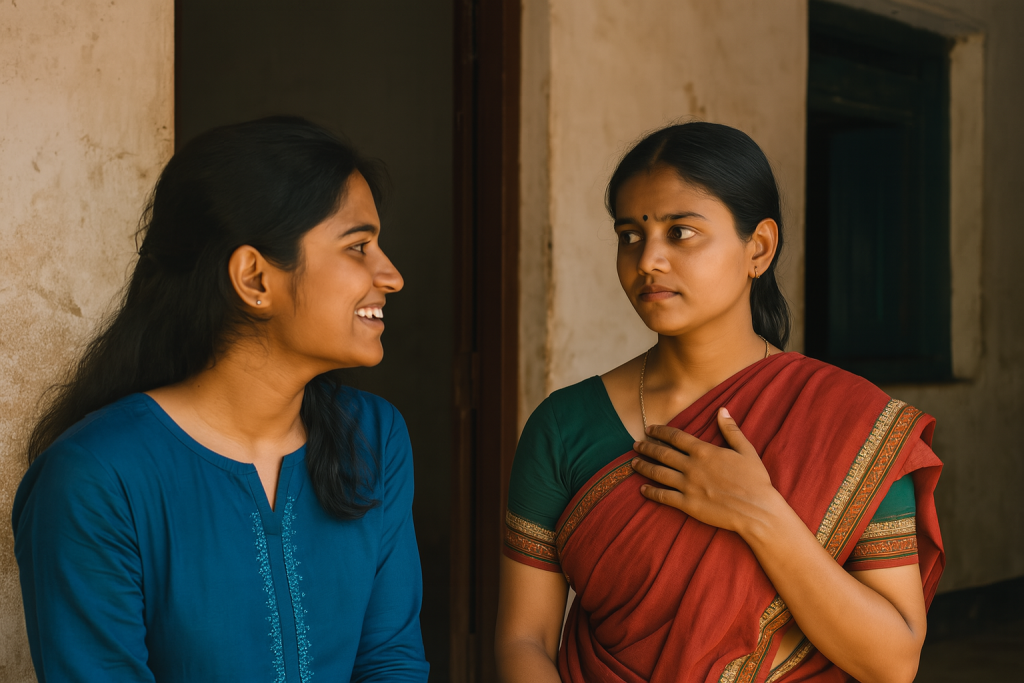
How I stopped labelling and judging people and discovered new friends

In this personal narrative, the author recounts transformative experiences that led to abandoning judgmental attitudes and embracing diversity. Through reflections on interpersonal encounters, the article underscores the importance of self-awareness, empathy, and openness in building genuine connections. The insights shared encourage a shift in mindset that fosters inclusivity and enriches both personal and professional relationships within the social sector.

Days came and nights passed. Everything was moving but me. I was stuck in my cubicle with heaps of books around, preparing for the UPSC exams. I was in my own bubble – studying for the exams, being with myself or meeting people who I thought were ‘like-minded’. I was quite judgmental, labelling and putting people into boxes and categories.


Did I enjoy being like this? No! All of this was troubling me and I didn’t like this attitude, but I couldn’t help myself. At a certain point, staying with a large group of people became a phobia for me.


When I got a call from ISDM, I was happy and excited. But I was also scared of meeting so many strangers. However, I was tired of what I had been doing and wanted a change in my life. I think that the best part in me is the capability to see myself, analyse my strengths and areas of improvement. I constantly work towards becoming better. The decision to join ISDM was an opportunity for me to be open to people, create new experiences and learn.


While the initial ice-breakers helped me talk to people – which, otherwise would have been difficult – I still found myself uncomfortable in engaging meaningfully.


Of all the concepts that I learnt during the orientation week, ‘socio-emotional intelligence’ got me thinking about my feelings and emotions. I asked myself ‘why I feel what I feel’ and ‘how I can grow into a better person’. As the concept unfolded, I learnt how my emotional tension was pulling me away from connecting with people.


Through context presentations, I connected with the beautiful journeys of ‘ISDM-ites’ and how their life experiences shaped their thoughts and opinions. This helped me connect with people beyond knowledge-pieces, views and opinions. I could see my emotions being reflected in them.


Today, I can proudly say that I have moved ahead from where I started.


Has this been easy? Certainly not. It is very easy to fall back on old habits and be in the ‘comfort zone’.


There are extremely painful days when my perceptions are challenged – when I can no longer be with people or when I see my old self in others. But there are many more beautiful days when I can see a shift in myself and be my most authentic self. I can shed my ego and be more open to other’s opinions. I am moved by love!


Today, all is not perfect. When I see myself falling into that trap, I make a conscious effort not to. I certainly have changed!


“Shedding these old dry leaves of doubt and suspicion,

I have embraced the blossoming spring,

Where every emotion comes floating to me in a cool breeze,

I open my colored petals one after another with each gentle touch.

Let this breeze be there for eternity,

And the season of bloom never end.”

Author(s) :

Yes

Get in touch with authors

No ratings yet

Rate this article

Yes

Key topics

Social Justice, Philanthropy and Human Rights

Also found in

Share

Join Our Newsletter

Explore More Articles

Paper / Report

Rethinking Impact: From Metrics to Meaning – Convening Report

How do we move beyond measuring impact as a reporting requirement to using it as a tool for learning, decision-making, and long-term change? This report captures the key discussions, insights, and emerging ideas from Rethinking Impact: From Metrics to Meaning, a convening that brought together funders, practitioners, researchers, evaluators, and development professionals to examine the future of impact measurement in India. Anchored around the launch of the Rural Development Impact Framework (RDIF) and the Development Management–Social Impact Measurement and Management (DM-SIMM) approach, the convening explored how the sector can better understand contribution, centre community perspectives, align funding with the realities of social change, and create measurement practices that support learning over compliance. The report synthesises the conversations, key takeaways, and actions that can help build a more thoughtful and effective approach to understanding impact.
Blog

Development Management: Genesis, Rationale, and the Foundations of an Emerging Discipline

Development Management (DM) arises at a junction that neither development studies nor mainstream management fully occupies on its own. Development thinking has traditionally concerned itself with what change is desirable and for whom, while management thinking has concerned itself with how collective effort gets organised and executed.
Paper / Report

A Methodological Framework for Assessing the Long-Term Impact of a Nonprofit’s Work in a Geography

This report presents the Rural Development Impact Framework (RDIF), a methodological approach for assessing the long-term impact of nonprofit organisations working within a geography. Drawing on realist evaluation, the framework shifts the focus from short-term, project-level attribution to understanding how sustained organisational engagement contributes to social change over time. Using PRADAN’s work in Gumla (Jharkhand) and Dhamtari (Chhattisgarh) as case studies, the research combines qualitative, quantitative, and geospatial methods to examine how interventions interact with local contexts to generate change. The study demonstrates that long-term impact emerges through the cumulative strengthening of livelihoods, institutions, collective agency, and governance systems, offering a practical framework for evaluating organisational contribution to rural transformation.
Paper / Report

DM-SIMM: A Funder’s Guide to Reflect, Learn, and Act on Social Impact

Across the social sector, impact measurement is often reduced to reporting numbers, meeting donor requirements, and proving results. In the process, opportunities for learning, adaptation, and meaningful decision-making are frequently lost. This guide explores how funders can rethink Social Impact Measurement and Management (SIMM) to prioritise continuous learning over compliance. Drawing on research, practitioner insights, and real-world examples, it offers practical ways to make measurement more useful, participatory, and responsive to the realities of implementation. The guide highlights the critical role of funders in shaping incentives, creating space for reflection, and enabling organisations to act on evidence. Ultimately, it presents a vision of impact practice that helps organisations learn, adapt, and stay focused on the change they seek to create.
We use essential and analytics cookies to operate this website and understand how visitors interact with it. As this site also functions as a login identity provider (IDP) for other ISDM portals, some cookies are necessary to enable secure authentication. By continuing to use this site, you consent to our use of cookies.