Not an IIT, IIM degree, but it’s the right mix of skill and will that a development sector aspirant should mandatorily possess
A fulfilling career in the social sector necessitates the right mix of academic knowledge and practical experience. Academic knowledge, gained through formal education, provides a strong foundation of theories, concepts, and research methodologies that can inform and guide one’s work in addressing social issues. This equips professionals with the analytical skills to understand the root causes of problems and the ability to develop evidence-based solutions. However, practical experience is equally vital, as it offers a real-world perspective, enabling individuals to bridge the gap between theory and application. It allows them to develop a deeper understanding of the communities and individuals they serve and build the interpersonal and problem-solving skills essential for effective intervention.
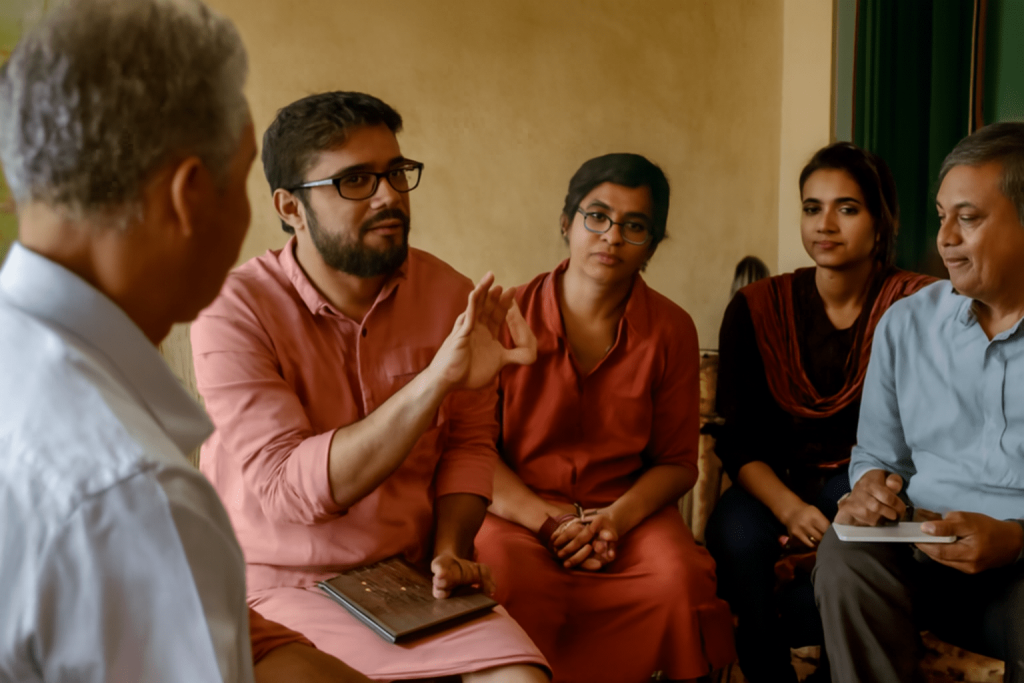
In a first-of-its-kind conference, Dialogues on Development Management (DoDM 2023), organised by ISDM to dive into the need for nurturing management for social change organised on 20 Sept 2023 in New Delhi, the house led by Rajesh Tandon (Founder-President, PRIA (Participatory Research in Asia)) and Wilma Rodrigues (Founder-CEO, Saahas Zero Waste) unpacked the prerequisites for a successful career in development sector.
The conversation emerged during the session Growing with Purpose: People at the Core presented by ISDM and PRADAN (Professional Assistance for Development Action). While ISDM believes in creating a generation of passionate Development Management professionals equipped with management skills, knowledge and experience for delivering social impact at scale, PRADAN brings educated professionals as catalysts to work alongside rural communities to empower vulnerable populations as drivers of change towards a decent life.
According to the speakers, practice takes a precedence in order of importance. While ‘skill’ comes from degrees, ‘will’ comes from experience and practice. Rajesh also indicated the role of COVID-19 in changing the perspective towards labour in the sector. He mentioned that, unlike earlier, COVID has made us realise that labour and work in the frontline is no less. They just lack a formal degree but excel at execution.
Wilma mentioned how an organisation can achieve this mix among young professionals starting off. She said that young people must be trained professionally for the right skills. However, the willingness and empathy for a cause come through exposure. They need to be exposed to and experience the problem first-hand. “You cannot promote participation without empathy,” she said. Alternatively, she pondered that hiring people directly from the community can be achieved when they have access to the right education and skill sets. Adding on to this, she said “A professional should do his work unsupervised, which cannot be achieved until someone is exposed to the complexities of the issue.” Saahas Zero Waste, which works towards sustainable waste management, advocates for putting young professionals in villages without toilets to understand the intensity of the problem.
Advocating for the role of a qualification or a degree, Rajesh mentioned that engineers and management graduates are equally crucial for the sector. “Technology does not replace humans but it increases efficiency,” he mentioned. Solutions in the social sector need contextualisation to the socio-economic and cultural factors. Tech know-how and management exposure help professionals adapt solutions to the context. This expertise also helps understand the laws of the land better to ensure smooth operations. Considering India’s complexity and federal structure, an organisation must be wary of local and national legalities to function. One also needs to understand politics, business institutions, and communities that primarily influence the design and modes of interventions.
Speaking of the changing context of attracting and retaining talents, Rajesh and Wilma mentioned the increasing demand for professionals in the sector; however, adapting them to the organisation’s specific needs remains a challenge. While many organisations like PRIA had to expand their physical presence to remote areas in the past to attract and keep talent closer to the ground, nowadays, peer pressure and pay force young people to look for opportunities in cities. To bring in the right mix of skill and will among the social sector aspirants, colleges offering degrees for professionals should have a compulsory ‘credit-based community immersion’ programme to acquaint the talents with the expectation vis-à-vis the realities and whether they want to sign up for this for a long haul. Policy studies should be linked to policy implementation, which can only be achieved with on-ground exposure.
During the second session of the fireside chat, Mathew Cherian (Global Ambassador, HelpAge International), Ajaya Samal (Integrator, PRADAN), and Aakash Sethi (Founder-CEO, Quest Alliance) focused on people’s perspectives on how an organisational culture can and should stay unchanged when organisations scale. Mathew mentioned that in the voluntary sector, compensation is not commensurate with what IIT and IIM graduates get elsewhere. Therefore, growth and scale-up must happen voluntarily and be driven by ethics and values. Talking about scaling organisations by design, Aakash pointed out whether one or two leaders or cascading a leadership architecture across the board should be involved in designing. He reiterated that leadership development is not equal to training programs but more about organisation making. Driving change becomes a practice of leadership, shaping the organisation’s culture.
“As organisations grow, whether people inside also grow becomes a question of the core,” added Aakash. He emphasised that the performance management system is also about knowing about career trajectories and possibilities to set growth opportunities. He espouses the idea that the individuals rather than the organisations should own individual growth possibilities and selection of the growth path.
Responding to how value and culture play a role in leadership, Mathew pointed out that ethical leadership needs accountability and transparency. Respecting the staff and partners is extremely important. The way the lowermost person is treated reflects an organisation’s culture. If there is participatory leadership, leaders should also know when and how to listen to their staff actively. Half of the job is done when people’s contribution is ensured in an organisation’s growth and it’s an integral part of the culture. Adding to this, Aakash mentioned that people, despite their designated roles and hierarchies, must be facilitated to participate in decision-making. There needs to be a space for dissent, significantly narrowed down by power and role hierarchy now.
Ajaya pointed out the other aspect of people’s perspective in an organisation’s development- grooming of young development professionals should consider them to be at the core, at the centre, to carry ahead the development action in the future and among the organisation leaders. The teams or the individual work units can provide the environment necessary to nurture an individual’s leadership abilities. They should be supportive and mutually helpful like members of the same family, physically and psychologically.
About authors: